Advertisements
Advertisements
प्रश्न
Distinguish between the free (or natural) and forced vibrations.
Advertisements
उत्तर
| Natural Vibration | Forced Vibration | |
| i. | An object's natural vibrations are its inherent vibrations, which occur at a consistent amplitude and frequency. |
Forced vibrations are those that occur as a result of being subjected to a periodic external force. |
| ii. | The amplitude changes with time. | Amplitude doesn't change throughout time. |
| iii. | The body's intrinsic frequency causes it to vibrate. | Does not move at its own natural frequency, but instead learns to deduce its own. |
APPEARS IN
संबंधित प्रश्न
Give one example to illustrate forced vibrations.
Differentiate between the forced and resonant vibrations.
A tuning fork of frequency 256 Hz will resonate with another tuning fork of frequency:
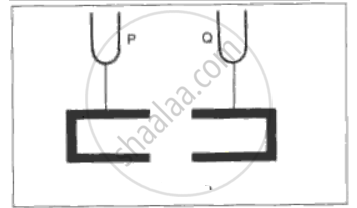
In fig. shows two tuning forks P and Q of the same frequency mounted on separate sound boxes with their open ends facing each other. The fork A is set into vibration. (i) Describe your observation. (ii) State the principle illustrated by this experiment.
On keeping the stem of a vibrating tuning fork on the surface of a table, a loud sound is heard. Give reason.
What do you mean by resonance? When does resonance occur?
Explain why stringed musical instruments, like the guitar, are provided with a hollow box.
State two ways in which resonance differs from forced vibrations.
The rearview mirror of a motorbike starts vibrating violently at some particular speed of the motorbike, what could be done to stop the violent vibrations.
