Advertisements
Advertisements
प्रश्न
Advertisements
उत्तर
Give that, speed of sound at 0° = 330 m/s
For every 1° rise in temperature, the velocity of sound increases by 0.61 m/s
`therefore` the velocity of sound at 10° = 330 + (0.61 x 10) = 330 + 6.1 = 336.1 m/s
Let A1 and A2 be the distances of the two walls from the point of refile shots. Thhen
2 x A1 = 336.1 x 3 = 1008.3 ...................(i)
2 x A2 = 336.1 x 6 = 2016.6 ...................(ii)
Adding (i) and (ii) we get
2 (A1 + A2) = 3024.9
or, (A1 + A2) = 1512.45 m
Thus the width of the velley is 1512.45 m
APPEARS IN
संबंधित प्रश्न
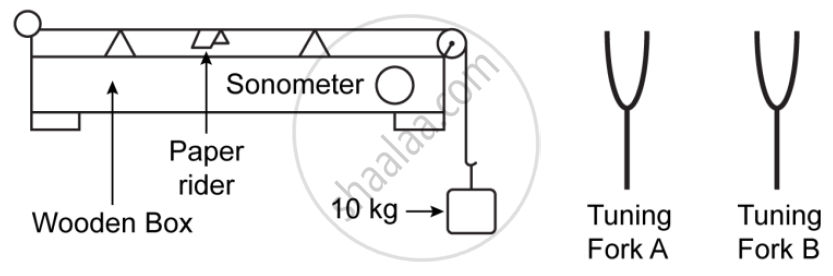
The diagram above shows a wire stretched over a sonometer. Stems of two vibrating tuning forks A and Bare touched to the wooden box of the sonometer. It is observed that the paper rider (a small piece of paper folded at the centre) present on the wire flies off when the stem of vibrating tuning fork B is touched to the wooden box but the paper just vibrates when the stem of vibrating tuning fork A is touched to the wooden box.
1) Name the phenomenon when the paper rider just vibrates.
2) Name the phenomenon when the paper rider flies off.
3) Why does the paper rider fly off when the stem of tuning fork B is touched to the box?
Resonance is a special case of ______ vibrations, when frequency of the driving force is ______ natural frequency of the body.
Why is a loud sound heard at resonance?
When a troop crosses a suspension bridge, the soldiers are asked to break steps. Explain the reason.
A tuning fork of frequency 256 Hz will resonate with another tuning fork of frequency:
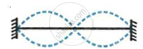
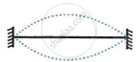
The diagram below shows three different modes of vibration P, Q and R of the same string of a given length.
 |
 |
 |
| P | Q | R |
- Which vibration will produce a louder sound and why?
- Which vibration will produce sound of maximum shrillness (or pitch) and why?
- What is the ratio of wavelength of vibrations P and R?
What do you mean by resonance? When does resonance occur?
Explain why stringed musical instruments, like the guitar, are provided with a hollow box.
Explain why does the rear mirror of a motorbike start Vibrating Violently, at some particular speed of motorbike?
When the stem of vibrating tuning fork is pressed on a table, the tabletop starts vibrating. These vibrations are definitely an example of ______.
