Advertisements
Advertisements
प्रश्न
Advertisements
उत्तर
Give that, speed of sound at 0° = 330 m/s
For every 1° rise in temperature, the velocity of sound increases by 0.61 m/s
`therefore` the velocity of sound at 10° = 330 + (0.61 x 10) = 330 + 6.1 = 336.1 m/s
Let A1 and A2 be the distances of the two walls from the point of refile shots. Thhen
2 x A1 = 336.1 x 3 = 1008.3 ...................(i)
2 x A2 = 336.1 x 6 = 2016.6 ...................(ii)
Adding (i) and (ii) we get
2 (A1 + A2) = 3024.9
or, (A1 + A2) = 1512.45 m
Thus the width of the velley is 1512.45 m
APPEARS IN
संबंधित प्रश्न
Define the resonance phenomenon.
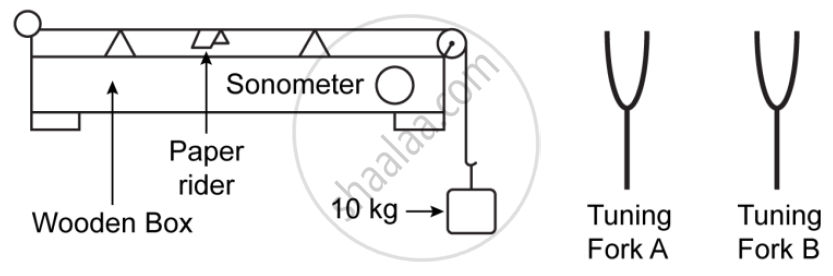
The diagram above shows a wire stretched over a sonometer. Stems of two vibrating tuning forks A and Bare touched to the wooden box of the sonometer. It is observed that the paper rider (a small piece of paper folded at the centre) present on the wire flies off when the stem of vibrating tuning fork B is touched to the wooden box but the paper just vibrates when the stem of vibrating tuning fork A is touched to the wooden box.
1) Name the phenomenon when the paper rider just vibrates.
2) Name the phenomenon when the paper rider flies off.
3) Why does the paper rider fly off when the stem of tuning fork B is touched to the box?
Differentiate between the forced and resonant vibrations.
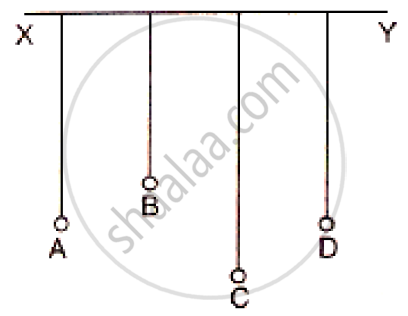
In following figure shows A, B, C and D are four pendulums suspended from the same elastic string XY. Lengths of pendulum A and D are equal, while the length of pendulum B is smaller and the pendulum C is longer. The pendulum A is set into vibration.
(a) what is your observation? (b) Give reason for your observation.
When acoustic resonance takes place, a loud sound is heard. Why does this happen? Explain.
The rearview mirror of a motorbike starts vibrating violently at some particular speed of the motorbike, what could be done to stop the violent vibrations.
Explain why does the rear mirror of a motorbike start Vibrating Violently, at some particular speed of motorbike?
Explain a tuning fork (vibrating) is held close to ear. One hears a faint sound. The same vibrating tuning fork is placed on table, such that its handle is in contact with table, one hears a loud sound.
When a tuning fork, struck by a rubber pad, is held over a length of the air column in a tube, it produces a loud sound for a fixed length of the air column. Name the above phenomenon. How does the frequency of the loud sound compare with that of the tuning fork? State the unit for measuring loudness.
What do you understand by forced vibrations?
