Advertisements
Advertisements
Question
Advertisements
Solution
Give that, speed of sound at 0° = 330 m/s
For every 1° rise in temperature, the velocity of sound increases by 0.61 m/s
`therefore` the velocity of sound at 10° = 330 + (0.61 x 10) = 330 + 6.1 = 336.1 m/s
Let A1 and A2 be the distances of the two walls from the point of refile shots. Thhen
2 x A1 = 336.1 x 3 = 1008.3 ...................(i)
2 x A2 = 336.1 x 6 = 2016.6 ...................(ii)
Adding (i) and (ii) we get
2 (A1 + A2) = 3024.9
or, (A1 + A2) = 1512.45 m
Thus the width of the velley is 1512.45 m
APPEARS IN
RELATED QUESTIONS
In the diagram below, A, B, C, D are four pendulums suspended from the same elastic string PQ. The lengths of A and C are equal to each other, while the length of pendulum B is smaller than that of D. Pendulum A is set into a mode of vibrations.
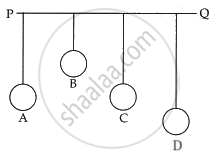
- Name the type of vibrations taking place in pendulums B and D.
- What is the state of pendulum C?
- State the reason for the type of vibrations in pendulums B and C.
What are forced vibrations?
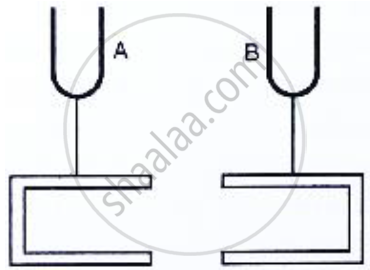
In following figure shows two tuning forks A and B of the same frequency mounted on two separate sound boxes with their open ends facing each other. The fork A is set into vibration.
- Describe your observation.
- State the principle illustrated by this experiment.
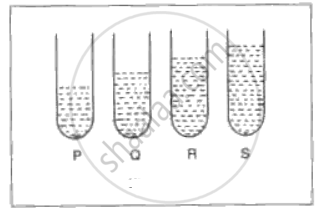
In fig. , P, Q, R and S represent test tubes each of height 20 cm which are filled with water upto heights of 10 cm, 14 cm, 16 cm and 18 cm respectively. If a vibrating tuning fork is placed over the mouth of test tube Q, a loud sound is heard.
(i) Describe the observations with the tubes P, R and S.
(ii) Give the reason for your observation in each case.
(iii) State the principle illustrated by the above experiment.
A bucket kept under a running tap is getting filled with water. A person sitting at a distance is able to get an idea when the bucket is about to be filled.
(i) What change takes place in the sound to give this idea?
(ii) What causes the change in the sound?
The rearview mirror of a motorbike starts vibrating violently at some particular speed of the motorbike. What is the name of the phenomenon taking place? Why does the happen?
Explain why are soldiers asked to walk out of step while crossing bridges?
What do you understand by free vibrations of a body? Draw a displacement-time graph to represent them. Given one example.
Describe a simple experiment to illustrate the phenomenon of resonance and explain it.
