Advertisements
Advertisements
Question
What do you understand by free vibrations of a body? Draw a displacement-time graph to represent them. Given one example.
Advertisements
Solution
The periodic vibrations of a body, of constant amplitude and constant frequency; are called free vibrations. The displacement-time graph to represent free vibrations of a body is given in the figure.
Example: A tuning fork vibrating in a vacuum.

RELATED QUESTIONS
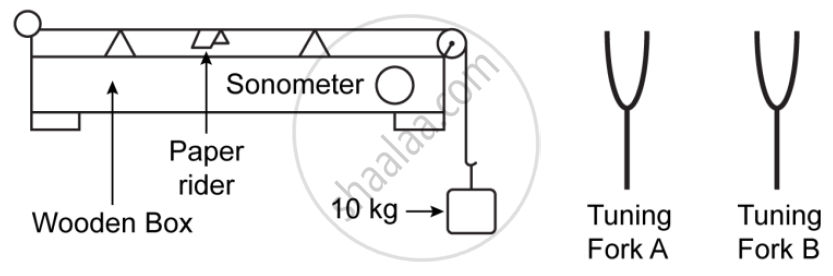
The diagram above shows a wire stretched over a sonometer. Stems of two vibrating tuning forks A and Bare touched to the wooden box of the sonometer. It is observed that the paper rider (a small piece of paper folded at the centre) present on the wire flies off when the stem of vibrating tuning fork B is touched to the wooden box but the paper just vibrates when the stem of vibrating tuning fork A is touched to the wooden box.
1) Name the phenomenon when the paper rider just vibrates.
2) Name the phenomenon when the paper rider flies off.
3) Why does the paper rider fly off when the stem of tuning fork B is touched to the box?
Which characteristic of sound makes it possible to recognize a person by his voice without seeing him?
Differentiate between the following:
Radio waves and light waves.
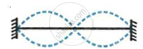
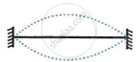
The diagram below shows three different modes of vibration P, Q and R of the same string of a given length.
 |
 |
 |
| P | Q | R |
- Which vibration will produce a louder sound and why?
- Which vibration will produce sound of maximum shrillness (or pitch) and why?
- What is the ratio of wavelength of vibrations P and R?
When acoustic resonance takes place, a loud sound is heard. Why does this happen? Explain.
Explain why are soldiers asked to walk out of step while crossing bridges?
Explain a person walking past a railway line, in the middle of night hears a ringing sound along with the sound of his footsteps.
What are the factors that affect the frequency of a vibrating string and how do they affect the frequency?
Explain free and forced vibrations. Give an experimental arrangement to illustrate the phenomenon of resonance.
