Advertisements
Advertisements
Question
A tuning fork of frequency 256 Hz will resonate with another tuning fork of frequency:
Options
128 Hz
256 Hz
384 Hz
512 Hz
Advertisements
Solution
A tuning fork of frequency 256 Hz will resonate with another tuning fork of frequency 256 Hz.
Hint: Resonance occurs when the frequency of an externally applied periodic force on the body is equal to its natural frequency.
RELATED QUESTIONS
Why is a loud sound heard at resonance?
When a troop crosses a suspension bridge, the soldiers are asked to break steps. Explain the reason.
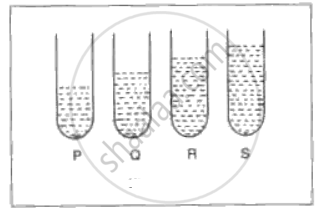
In fig. , P, Q, R and S represent test tubes each of height 20 cm which are filled with water upto heights of 10 cm, 14 cm, 16 cm and 18 cm respectively. If a vibrating tuning fork is placed over the mouth of test tube Q, a loud sound is heard.
(i) Describe the observations with the tubes P, R and S.
(ii) Give the reason for your observation in each case.
(iii) State the principle illustrated by the above experiment.
A bucket kept under a running tap is getting filled with water. A person sitting at a distance is able to get an idea when the bucket is about to be filled.
(i) What change takes place in the sound to give this idea?
(ii) What causes the change in the sound?
Explain why stringed musical instruments, like the guitar, are provided with a hollow box.
The rearview mirror of a motorbike starts vibrating violently at some particular speed of the motorbike. What is the name of the phenomenon taking place? Why does the happen?
Explain a person walking past a railway line, in the middle of night hears a ringing sound along with the sound of his footsteps.
Explain Why are stringed musical instruments provided with large sound boxes?
Explain free and forced vibrations. Give an experimental arrangement to illustrate the phenomenon of resonance.
Describe a simple experiment to illustrate the phenomenon of resonance and explain it.
