Advertisements
Advertisements
Question
In the diagram below, A, B, C, D are four pendulums suspended from the same elastic string PQ. The lengths of A and C are equal to each other, while the length of pendulum B is smaller than that of D. Pendulum A is set into a mode of vibrations.
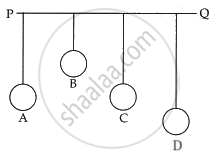
- Name the type of vibrations taking place in pendulums B and D.
- What is the state of pendulum C?
- State the reason for the type of vibrations in pendulums B and C.
Advertisements
Solution
1) The vibrations which occur in pendulums B and D are called forced vibrations.
2) Pendulum C is in the state of resonance with pendulum A as it is of the same length.
3) The pendulums vibrate because the forced vibration from A is transferred due to string PQ.
Pendulum B is of a different length as compared to pendulum A. Hence, it will continuously vibrate with a frequency which is different from that of pendulum A. Its amplitude will also be very small.
Pendulum C is of the same length as compared to pendulum A. Hence, it will vibrate in phase with pendulum A. Its amplitude will be equal to that of pendulum A, as it will attain resonance.
RELATED QUESTIONS
When a body vibrates under a periodic force, the vibrations of the body are ______.
Two pendulums C and D are suspended from a wire as shown in the figure give below. Pendulum C is made to oscullate by displaying it from its mean position. It is seen that D also starts oscillating.
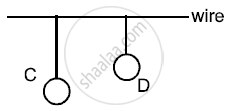
(i) Name the type of oscillation, C will execute.
(ii) Name the type of oscillation, D will execute.
(iii) If the length of D is made equal to C then what difference will you notice in the oscillations of D ?
(iv) What is the name of the phenomenon when the length of D is made equal to C ?
Differentiate between the following:
Radio waves and light waves.
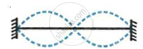
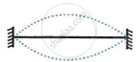
The diagram below shows three different modes of vibration P, Q and R of the same string of a given length.
 |
 |
 |
| P | Q | R |
- Which vibration will produce a louder sound and why?
- Which vibration will produce sound of maximum shrillness (or pitch) and why?
- What is the ratio of wavelength of vibrations P and R?
State two ways in which resonance differs from forced vibrations.
What do you understand by free (or natural) vibrations?
What do you understand by forced vibrations?
What do you understand by free vibrations of a body? Draw a displacement-time graph to represent them. Given one example.
Explain free and forced vibrations. Give an experimental arrangement to illustrate the phenomenon of resonance.
