Advertisements
Advertisements
Question
Name the phenomenon involved in tuning your radio set to a particular station and define it.
Advertisements
Solution
The phenomenon involved is resonance. It is a special case of forced vibrations. When the frequency of an externally applied periodic force on a body is equal to its natural frequency, the body rapidly begins to vibrate with an increased amplitude. This phenomenon is known as resonance.
RELATED QUESTIONS
Name the phenomenon involved in tunning a radio set to a particular station.
Differentiate between the forced and resonant vibrations.
In fig. shows two tuning forks P and Q of the same frequency mounted on separate sound boxes with their open ends facing each other. The fork A is set into vibration. (i) Describe your observation. (ii) State the principle illustrated by this experiment.

In Fig. A, B, C and D are four pendulums suspended from the same elastic string XY. The lengths of pendulum A and D are equal, while the length of pendulum B is shorter and of the pendulum C is longer. Pendulum A is set into vibrations.

- What is your observation about the vibrations of pendulum D?
- Give reason for your observation in part (a).
- What type of vibrations take place in pendulums Band C?
- Give reason for the answer in part (c).
Differentiate between the following:
Free and forced vibrations.
The diagram below shows three different modes of vibration P, Q and R of the same string of a given length.
 |
 |
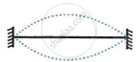 |
| P | Q | R |
- Which vibration will produce a louder sound and why?
- Which vibration will produce sound of maximum shrillness (or pitch) and why?
- What is the ratio of wavelength of vibrations P and R?
Explain why stringed musical instruments, like the guitar, are provided with a hollow box.
Explain free and forced vibrations. Give an experimental arrangement to illustrate the phenomenon of resonance.
