Advertisements
Advertisements
Question
Differentiate between the following:
Radio waves and light waves.
Advertisements
Solution
| Radio waves | Light waves |
| 1. Radio waves are not visible to hum an eye. | 1. Light waves are visible to human eye. |
| 2. These waves range from 105 to 10-3 meters. | 2. These waves range from 10-6 to 10-7 meters. |
| 3. Frequency of radio waves is below 107 Hz. | 3. Frequency of light waves lie in the range 1014 to 1013 Hz. |
| 4. Its sources are TV and radio transmitters. | 4. Its sources are sunlight, white hot bodies. |
APPEARS IN
RELATED QUESTIONS
Why are the stringed instruments like guitar provided with a hollow sound box?
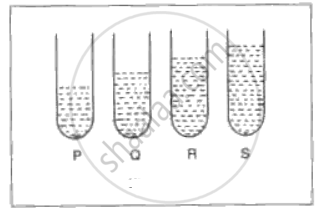
In fig. , P, Q, R and S represent test tubes each of height 20 cm which are filled with water upto heights of 10 cm, 14 cm, 16 cm and 18 cm respectively. If a vibrating tuning fork is placed over the mouth of test tube Q, a loud sound is heard.
(i) Describe the observations with the tubes P, R and S.
(ii) Give the reason for your observation in each case.
(iii) State the principle illustrated by the above experiment.
On keeping the stem of a vibrating tuning fork on the surface of a table, a loud sound is heard. Give reason.
A bucket kept under a running tap is getting filled with water. A person sitting at a distance is able to get an idea when the bucket is about to be filled.
(i) What change takes place in the sound to give this idea?
(ii) What causes the change in the sound?
Give two examples of forced vibrations.
Explain why are soldiers asked to walk out of step while crossing bridges?
When a tuning fork, struck by a rubber pad, is held over a length of the air column in a tube, it produces a loud sound for a fixed length of the air column. Name the above phenomenon. How does the frequency of the loud sound compare with that of the tuning fork? State the unit for measuring loudness.
Describe a simple experiment to illustrate the phenomenon of resonance and explain it.
