Advertisements
Advertisements
Question
Advertisements
Solution
RELATED QUESTIONS
The adjacent diagram shows three different modes of vibrations P, Q and R of the same string.
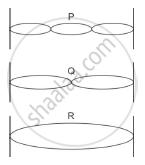
(i) Which vibration will produce a louder sound and why?
(ii) The sound of which string will have maximum shrillness?
(iii) State the ratio of wavelengths of P and R.
A vibrating tuning fork, held over an air column of a given length with its one end closed, produces a loud audible sound. Name the phenomenon responsible for it and explain the observation.
In following figure shows A, B , C and D represent test tube each of height 20 cm which are filled with water up to heights of 12 cm, 14 cm, 16cm and 18cm respectively. If a vibrating tuning fork is placed over the mouth if test tube D, a loud sound is heard.

- Describe the observations with the tubes A, B and C when the vibrating tuning fork is placed over the mouth of these tubes.
- Give the reason for your observation in each case.
- State the principle illustrated by the above experiment.
When a body vibrates under a periodic force, the vibrations of the body are ______.
A tuning fork of frequency 256 Hz will resonate with another tuning fork of frequency:
Differentiate between the following:
Light and sound waves.
Give two examples of forced vibrations.
The rearview mirror of a motorbike starts vibrating violently at some particular speed of the motorbike, what could be done to stop the violent vibrations.
Explain a tuning fork (vibrating) is held close to ear. One hears a faint sound. The same vibrating tuning fork is placed on table, such that its handle is in contact with table, one hears a loud sound.
A string stretched between its ends is made to vibrate by placing the stem of a vibrating tuning fork at its one end. State three ways how you will increase the frequency of note produced by the string.
