Advertisements
Advertisements
प्रश्न
Advertisements
उत्तर
संबंधित प्रश्न
Give one example to illustrate forced vibrations.
Differentiate between the forced and resonant vibrations.
How do you tune your radio set to a particular station ? Name the phenomenon involved in doing so and define it.
Two pendulums C and D are suspended from a wire as shown in the figure give below. Pendulum C is made to oscullate by displaying it from its mean position. It is seen that D also starts oscillating.
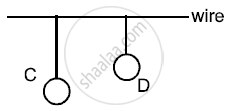
(i) Name the type of oscillation, C will execute.
(ii) Name the type of oscillation, D will execute.
(iii) If the length of D is made equal to C then what difference will you notice in the oscillations of D ?
(iv) What is the name of the phenomenon when the length of D is made equal to C ?
Give two examples of forced vibrations.
Explain why does the rear mirror of a motorbike start Vibrating Violently, at some particular speed of motorbike?
A string stretched between its ends is made to vibrate by placing the stem of a vibrating tuning fork at its one end. State three ways how you will increase the frequency of note produced by the string.
What are the factors that affect the frequency of a vibrating string and how do they affect the frequency?
