Advertisements
Advertisements
प्रश्न
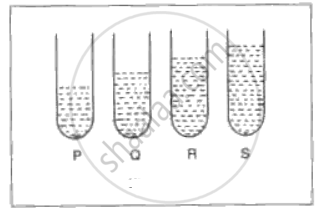
In fig. , P, Q, R and S represent test tubes each of height 20 cm which are filled with water upto heights of 10 cm, 14 cm, 16 cm and 18 cm respectively. If a vibrating tuning fork is placed over the mouth of test tube Q, a loud sound is heard.
(i) Describe the observations with the tubes P, R and S.
(ii) Give the reason for your observation in each case.
(iii) State the principle illustrated by the above experiment.
Advertisements
उत्तर
(i) No loud sound is heard with P and R but a loud sound is heard with S.
(ii) Resonance occurs with the air column in tubes Q and S whereas no resonance occurs in the air columns of tubes P and R. The frequency of vibrations of air column in the tube S is thrice the frequency of vibrations of air column in the tube Q, while the frequency of vibrations of air column in tubes P and R is neither equal to nor an integer multiple of frequency of vibrations of air column in tube Q.
(iii) When the frequency of vibrations of air column is either equal to or an integer multiple of the frequency of the vibrating tuning fork, resonance occurs.
APPEARS IN
संबंधित प्रश्न
How does the medium affect the amplitude of free/natural vibrations of a body?
Why is a loud sound heard at resonance?
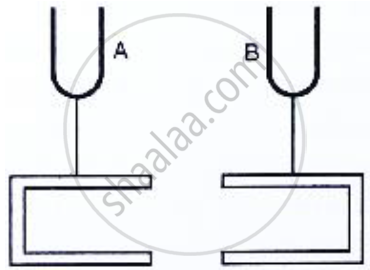
In following figure shows two tuning forks A and B of the same frequency mounted on two separate sound boxes with their open ends facing each other. The fork A is set into vibration.
- Describe your observation.
- State the principle illustrated by this experiment.
In following figure shows A, B , C and D represent test tube each of height 20 cm which are filled with water up to heights of 12 cm, 14 cm, 16cm and 18cm respectively. If a vibrating tuning fork is placed over the mouth if test tube D, a loud sound is heard.

- Describe the observations with the tubes A, B and C when the vibrating tuning fork is placed over the mouth of these tubes.
- Give the reason for your observation in each case.
- State the principle illustrated by the above experiment.
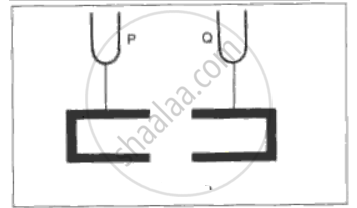
In fig. shows two tuning forks P and Q of the same frequency mounted on separate sound boxes with their open ends facing each other. The fork A is set into vibration. (i) Describe your observation. (ii) State the principle illustrated by this experiment.
What do you mean by resonance? When does resonance occur?
When a tuning fork, struck by a rubber pad, is held over a length of the air column in a tube, it produces a loud sound for a fixed length of the air column. Name the above phenomenon. How does the frequency of the loud sound compare with that of the tuning fork? State the unit for measuring loudness.
A string stretched between its ends is made to vibrate by placing the stem of a vibrating tuning fork at its one end. State three ways how you will increase the frequency of note produced by the string.
What do you understand by forced vibrations?
Describe a simple experiment to illustrate the phenomenon of resonance and explain it.
