Advertisements
Advertisements
प्रश्न
Explain why are soldiers asked to walk out of step while crossing bridges?
Advertisements
उत्तर
When the soldiers walk in step, they produce some fixed frequency. If this frequency corresponds to the natural frequency of the bridge, the resonance can take place. This, in turn, will make the bridge to vibrate violently, and hence make it collapse. To avoid such a situation, the soldiers are asked not to march in step.
संबंधित प्रश्न
The adjacent diagram shows three different modes of vibrations P, Q and R of the same string.
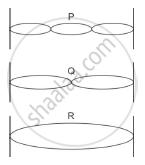
(i) Which vibration will produce a louder sound and why?
(ii) The sound of which string will have maximum shrillness?
(iii) State the ratio of wavelengths of P and R.
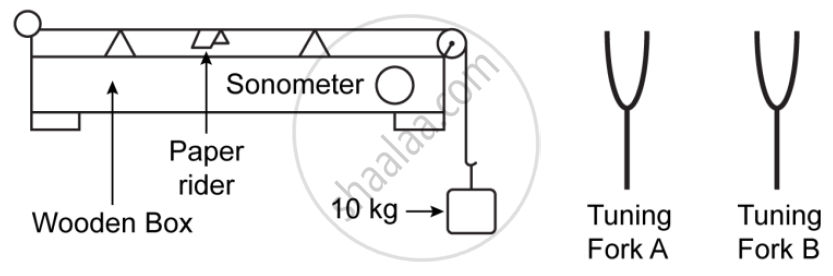
The diagram above shows a wire stretched over a sonometer. Stems of two vibrating tuning forks A and Bare touched to the wooden box of the sonometer. It is observed that the paper rider (a small piece of paper folded at the centre) present on the wire flies off when the stem of vibrating tuning fork B is touched to the wooden box but the paper just vibrates when the stem of vibrating tuning fork A is touched to the wooden box.
1) Name the phenomenon when the paper rider just vibrates.
2) Name the phenomenon when the paper rider flies off.
3) Why does the paper rider fly off when the stem of tuning fork B is touched to the box?
What are forced vibrations?
In following figure shows A, B , C and D represent test tube each of height 20 cm which are filled with water up to heights of 12 cm, 14 cm, 16cm and 18cm respectively. If a vibrating tuning fork is placed over the mouth if test tube D, a loud sound is heard.

- Describe the observations with the tubes A, B and C when the vibrating tuning fork is placed over the mouth of these tubes.
- Give the reason for your observation in each case.
- State the principle illustrated by the above experiment.
Name the phenomenon involved in tuning your radio set to a particular station and define it.
Differentiate between the following:
Free and forced vibrations.
Explain why does the rear mirror of a motorbike start Vibrating Violently, at some particular speed of motorbike?
Explain a tuning fork (vibrating) is held close to ear. One hears a faint sound. The same vibrating tuning fork is placed on table, such that its handle is in contact with table, one hears a loud sound.
