Advertisements
Advertisements
Question
How do you tune your radio set to a particular station ? Name the phenomenon involved in doing so and define it.
Advertisements
Solution
Resonance is the basis for radio tuning. You may alter the frequency of the electrical vibrations produced by them by adjusting the values of the individual components in the electronic circuits that make them up. Changing the values of a few electrical components causes vibrations at a frequency that matches the desired radio wave frequency, and that's all. When the two frequencies are in resonance with one another, the incoming waves carry the signal energy of the matching frequency. In the receiver set, the signal is then amplified.
APPEARS IN
RELATED QUESTIONS
Resonance is a special case of ______ vibrations, when frequency of the driving force is ______ natural frequency of the body.
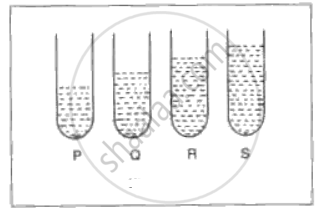
In fig. , P, Q, R and S represent test tubes each of height 20 cm which are filled with water upto heights of 10 cm, 14 cm, 16 cm and 18 cm respectively. If a vibrating tuning fork is placed over the mouth of test tube Q, a loud sound is heard.
(i) Describe the observations with the tubes P, R and S.
(ii) Give the reason for your observation in each case.
(iii) State the principle illustrated by the above experiment.
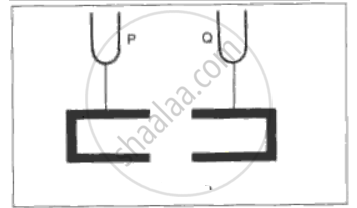
In fig. shows two tuning forks P and Q of the same frequency mounted on separate sound boxes with their open ends facing each other. The fork A is set into vibration. (i) Describe your observation. (ii) State the principle illustrated by this experiment.
Differentiate between the following:
Radio waves and light waves.
When acoustic resonance takes place, a loud sound is heard. Why does this happen? Explain.
The rearview mirror of a motorbike starts vibrating violently at some particular speed of the motorbike. What is the name of the phenomenon taking place? Why does the happen?
The rearview mirror of a motorbike starts vibrating violently at some particular speed of the motorbike, what could be done to stop the violent vibrations.
When a tuning fork, struck by a rubber pad, is held over a length of the air column in a tube, it produces a loud sound for a fixed length of the air column. Name the above phenomenon. How does the frequency of the loud sound compare with that of the tuning fork? State the unit for measuring loudness.
What are the factors that affect the frequency of a vibrating string and how do they affect the frequency?
