Advertisements
Advertisements
प्रश्न
What do you understand by free vibrations of a body? Draw a displacement-time graph to represent them. Given one example.
Advertisements
उत्तर
The periodic vibrations of a body, of constant amplitude and constant frequency; are called free vibrations. The displacement-time graph to represent free vibrations of a body is given in the figure.
Example: A tuning fork vibrating in a vacuum.

संबंधित प्रश्न
Give one example to illustrate forced vibrations.
In following figure shows two tuning forks A and B of the same frequency mounted on two separate sound boxes with their open ends facing each other. The fork A is set into vibration.
- Describe your observation.
- State the principle illustrated by this experiment.
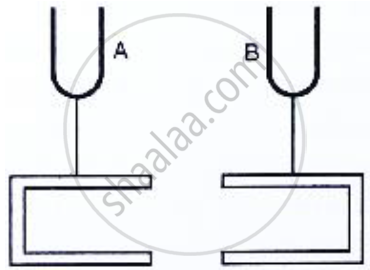
Why are the stringed instruments like guitar provided with a hollow sound box?
Which characteristic of sound makes it possible to recognize a person by his voice without seeing him?
The rearview mirror of a motorbike starts vibrating violently at some particular speed of the motorbike, what could be done to stop the violent vibrations.
A vibrating tuning fork is placed over the mouth of a burette filled with water. The tap is opened and the water level gradually falls. It is observed that the sound becomes the loudest for a particular length of the air column. What is the name of the phenomenon taking place when this happens? Why does the sound become the loudest?
When a tuning fork, struck by a rubber pad, is held over a length of the air column in a tube, it produces a loud sound for a fixed length of the air column. Name the above phenomenon. How does the frequency of the loud sound compare with that of the tuning fork? State the unit for measuring loudness.
A string stretched between its ends is made to vibrate by placing the stem of a vibrating tuning fork at its one end. State three ways how you will increase the frequency of note produced by the string.
Explain free and forced vibrations. Give an experimental arrangement to illustrate the phenomenon of resonance.
