Advertisements
Advertisements
प्रश्न
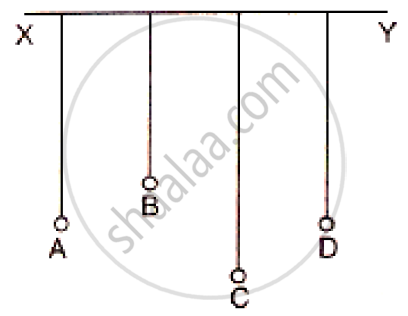
In following figure shows A, B, C and D are four pendulums suspended from the same elastic string XY. Lengths of pendulum A and D are equal, while the length of pendulum B is smaller and the pendulum C is longer. The pendulum A is set into vibration.
(a) what is your observation? (b) Give reason for your observation.
Advertisements
उत्तर
(a) Set the pendulum A into vibration by displacing it to one side, normal to its length. It is observed that pendulum D also starts vibrating initially with a small amplitude and ultimately it acquires the same amplitude as the pendulum A initially had. When the amplitude of the pendulum D becomes maximum, the amplitude of the pendulum A becomes minimum since the total energy is constant. After some time the amplitude of the pendulum D will decreases and amplitude of A increases. The exchange of energy takes place only between the pendulums A and D because their natural frequencies are same. The pendulums B and C also vibrate, but with very small amplitudes.
(b) The vibrations produced in pendulum A are communicated as forced vibrations to the other pendulums B, C and D through XY. The pendulums B and C remain in the state of forced vibrations, while the pendulum D comes in the state of resonance.
संबंधित प्रश्न
Define the resonance phenomenon.
Give one example to illustrate forced vibrations.
How do you tune your radio set to a particular station ? Name the phenomenon involved in doing so and define it.
Two pendulums C and D are suspended from a wire as shown in the figure give below. Pendulum C is made to oscullate by displaying it from its mean position. It is seen that D also starts oscillating.
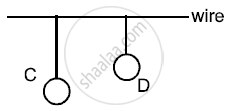
(i) Name the type of oscillation, C will execute.
(ii) Name the type of oscillation, D will execute.
(iii) If the length of D is made equal to C then what difference will you notice in the oscillations of D ?
(iv) What is the name of the phenomenon when the length of D is made equal to C ?
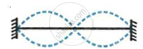
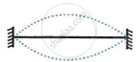
The diagram below shows three different modes of vibration P, Q and R of the same string of a given length.
 |
 |
 |
| P | Q | R |
- Which vibration will produce a louder sound and why?
- Which vibration will produce sound of maximum shrillness (or pitch) and why?
- What is the ratio of wavelength of vibrations P and R?
Give two examples of forced vibrations.
Explain why are soldiers asked to walk out of step while crossing bridges?
Explain why does the rear mirror of a motorbike start Vibrating Violently, at some particular speed of motorbike?
