Advertisements
Advertisements
प्रश्न
When the stem of vibrating tuning fork is pressed on a table, the tabletop starts vibrating. These vibrations are definitely an example of ______.
पर्याय
Resonance
Natural vibrations
Forced vibrations
Damped vibrations
Advertisements
उत्तर
When the stem of vibrating tuning fork is pressed on a table, the tabletop starts vibrating. These vibrations are definitely an example of Forced vibrations.
Explanation:
This occurs because the tuning fork forces the tabletop to vibrate at its own frequency.
APPEARS IN
संबंधित प्रश्न
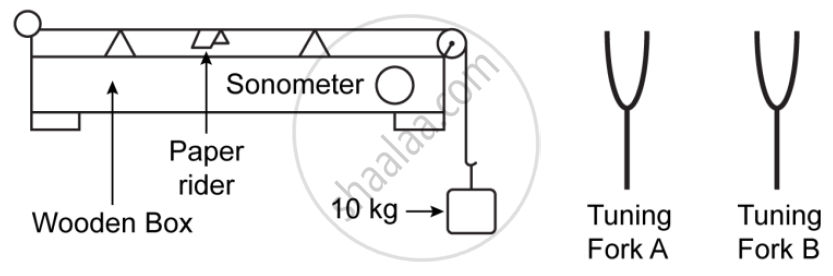
The diagram above shows a wire stretched over a sonometer. Stems of two vibrating tuning forks A and Bare touched to the wooden box of the sonometer. It is observed that the paper rider (a small piece of paper folded at the centre) present on the wire flies off when the stem of vibrating tuning fork B is touched to the wooden box but the paper just vibrates when the stem of vibrating tuning fork A is touched to the wooden box.
1) Name the phenomenon when the paper rider just vibrates.
2) Name the phenomenon when the paper rider flies off.
3) Why does the paper rider fly off when the stem of tuning fork B is touched to the box?
How does the medium affect the amplitude of free/natural vibrations of a body?
Distinguish between the free (or natural) and forced vibrations.
Describe a simple experiment to illustrate the phenomenon of resonance and explain it.
Why are the stringed instruments like guitar provided with a hollow sound box?
When a body vibrates under a periodic force, the vibrations of the body are ______.
Differentiate between the following:
Free and forced vibrations.
Give two examples of forced vibrations.
