Advertisements
Advertisements
प्रश्न
When a troop crosses a suspension bridge, the soldiers are asked to break steps. Explain the reason.
When a troop crosses a suspension bridge, the soldiers are asked to break their steps. Why?
Advertisements
उत्तर
When a troop crosses a suspension bridge, the soldiers are asked to break steps. The reason is that when soldiers march in steps, all the separate periodic forces exerted by them are in same phase and therefore forced vibrations of a particular frequency are produced in the bridge. Now, if the natural frequency of the bridge happens to be equal to the frequency of the steps, the bridge will vibrate with large amplitude due to resonance and suspension bridge could crumble.
संबंधित प्रश्न
Define the resonance phenomenon.
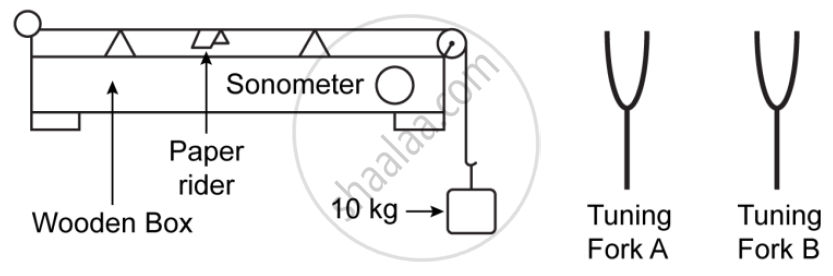
The diagram above shows a wire stretched over a sonometer. Stems of two vibrating tuning forks A and Bare touched to the wooden box of the sonometer. It is observed that the paper rider (a small piece of paper folded at the centre) present on the wire flies off when the stem of vibrating tuning fork B is touched to the wooden box but the paper just vibrates when the stem of vibrating tuning fork A is touched to the wooden box.
1) Name the phenomenon when the paper rider just vibrates.
2) Name the phenomenon when the paper rider flies off.
3) Why does the paper rider fly off when the stem of tuning fork B is touched to the box?
A vibrating tuning fork, held over an air column of a given length with its one end closed, produces a loud audible sound. Name the phenomenon responsible for it and explain the observation.
Two pendulums C and D are suspended from a wire as shown in the figure give below. Pendulum C is made to oscullate by displaying it from its mean position. It is seen that D also starts oscillating.
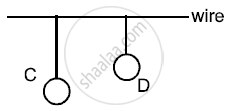
(i) Name the type of oscillation, C will execute.
(ii) Name the type of oscillation, D will execute.
(iii) If the length of D is made equal to C then what difference will you notice in the oscillations of D ?
(iv) What is the name of the phenomenon when the length of D is made equal to C ?
Give two examples of forced vibrations.
Explain why stringed musical instruments, like the guitar, are provided with a hollow box.
The rearview mirror of a motorbike starts vibrating violently at some particular speed of the motorbike, what could be done to stop the violent vibrations.
A vibrating tuning fork is placed over the mouth of a burette filled with water. The tap is opened and the water level gradually falls. It is observed that the sound becomes the loudest for a particular length of the air column. What is the name of the phenomenon taking place when this happens? Why does the sound become the loudest?
Explain a person walking past a railway line, in the middle of night hears a ringing sound along with the sound of his footsteps.
