Advertisements
Advertisements
प्रश्न
Advertisements
उत्तर
Frequency of vibrations of a stretched string depends upon:
1. Frequency of the fundamental note of a stretched string is inversely proportional to the length of the vibrating string.
2. Frequency is directly proportional to the square root of the tension of the string.
3. Frequency is inversely proportional to the square root of linear density. That is, mass per unit length of the material of the string. Thinner is the wire, higher is the frequency.
APPEARS IN
संबंधित प्रश्न
In the diagram below, A, B, C, D are four pendulums suspended from the same elastic string PQ. The lengths of A and C are equal to each other, while the length of pendulum B is smaller than that of D. Pendulum A is set into a mode of vibrations.
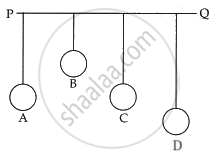
- Name the type of vibrations taking place in pendulums B and D.
- What is the state of pendulum C?
- State the reason for the type of vibrations in pendulums B and C.
What are mechanical waves?
Why are the stringed instruments like guitar provided with a hollow sound box?
How do you tune your radio set to a particular station ? Name the phenomenon involved in doing so and define it.
Name the phenomenon involved in tuning your radio set to a particular station and define it.
When a body vibrates under a periodic force, the vibrations of the body are ______.
A tuning fork of frequency 256 Hz will resonate with another tuning fork of frequency:
Explain a tuning fork (vibrating) is held close to ear. One hears a faint sound. The same vibrating tuning fork is placed on table, such that its handle is in contact with table, one hears a loud sound.
Explain free and forced vibrations. Give an experimental arrangement to illustrate the phenomenon of resonance.
When the stem of vibrating tuning fork is pressed on a table, the tabletop starts vibrating. These vibrations are definitely an example of ______.
