Advertisements
Advertisements
प्रश्न
Explain free and forced vibrations. Give an experimental arrangement to illustrate the phenomenon of resonance.
Advertisements
उत्तर
When a system or a body vibrates without receiving impulses from another system or body, its vibrations are said to be free vibrations. However, when a system or body vibrates on account of impulses received from another system or body, the vibrations are called forced vibrations. In such a case the body or the system vibrates with the frequency of the impulses received and not with its natural frequency.

Experiment Arrangement to illustrate Resonance: In the figure, the two pendulums have exactly equal lengths. However, the bob of the pendulum A is heavier. Displace the bob of the pendulum A by a little distance in a direction perpendicular to the plane containing the two pendulums. Then release the bob. The pendulum A will begin to oscillate. After a short while, you will find that the pendulum B also begins to vibrate. Note that the two pendulums have the same frequency. The pendulum A through the rubber tube applies impulses of the same frequency on the pendulum B Hence, the pendulum B begins to vibrate.
संबंधित प्रश्न
Define the resonance phenomenon.
How does the medium affect the amplitude of free/natural vibrations of a body?
In following figure shows A, B , C and D represent test tube each of height 20 cm which are filled with water up to heights of 12 cm, 14 cm, 16cm and 18cm respectively. If a vibrating tuning fork is placed over the mouth if test tube D, a loud sound is heard.

- Describe the observations with the tubes A, B and C when the vibrating tuning fork is placed over the mouth of these tubes.
- Give the reason for your observation in each case.
- State the principle illustrated by the above experiment.
In fig. , P, Q, R and S represent test tubes each of height 20 cm which are filled with water upto heights of 10 cm, 14 cm, 16 cm and 18 cm respectively. If a vibrating tuning fork is placed over the mouth of test tube Q, a loud sound is heard.
(i) Describe the observations with the tubes P, R and S.
(ii) Give the reason for your observation in each case.
(iii) State the principle illustrated by the above experiment.

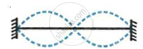
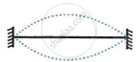
The diagram below shows three different modes of vibration P, Q and R of the same string of a given length.
 |
 |
 |
| P | Q | R |
- Which vibration will produce a louder sound and why?
- Which vibration will produce sound of maximum shrillness (or pitch) and why?
- What is the ratio of wavelength of vibrations P and R?
A bucket kept under a running tap is getting filled with water. A person sitting at a distance is able to get an idea when the bucket is about to be filled.
(i) What change takes place in the sound to give this idea?
(ii) What causes the change in the sound?
State two ways in which resonance differs from forced vibrations.
A string stretched between its ends is made to vibrate by placing the stem of a vibrating tuning fork at its one end. State three ways how you will increase the frequency of note produced by the string.
Explain Why are stringed musical instruments provided with large sound boxes?
