Advertisements
Advertisements
प्रश्न
Describe a simple experiment to illustrate the phenomenon of resonance and explain it.
Advertisements
उत्तर
Mount two identical tuning forks A and B of same frequency upon two separate sound boxes such that their open ends face each other as shown.

If the prong A is struck on a rubber pad, it starts vibrating. On putting A on its sound box, tuning
fork B also starts vibrating and a loud sound is heard. The vibrations produced in B are due to
resonance.
संबंधित प्रश्न
Why are the stringed instruments like guitar provided with a hollow sound box?
Name the phenomenon involved in tuning your radio set to a particular station and define it.
Two pendulums C and D are suspended from a wire as shown in the figure give below. Pendulum C is made to oscullate by displaying it from its mean position. It is seen that D also starts oscillating.
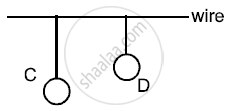
(i) Name the type of oscillation, C will execute.
(ii) Name the type of oscillation, D will execute.
(iii) If the length of D is made equal to C then what difference will you notice in the oscillations of D ?
(iv) What is the name of the phenomenon when the length of D is made equal to C ?
Differentiate between the following:
Radio waves and light waves.
On keeping the stem of a vibrating tuning fork on the surface of a table, a loud sound is heard. Give reason.
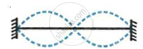
The diagram below shows three different modes of vibration P, Q and R of the same string of a given length.
 |
 |
 |
| P | Q | R |
- Which vibration will produce a louder sound and why?
- Which vibration will produce sound of maximum shrillness (or pitch) and why?
- What is the ratio of wavelength of vibrations P and R?
What do you mean by resonance? When does resonance occur?
Explain why stringed musical instruments, like the guitar, are provided with a hollow box.
State two ways in which resonance differs from forced vibrations.
What do you understand by free (or natural) vibrations?
