Advertisements
Advertisements
प्रश्न
Advertisements
उत्तर
When the frequency of the forced vibration is equal to the natural frequency of a body nearby or an integer multiple of it then the body vibrates with a large amplitude. This phenomenon is called resonance.
E.g.1 all stringed instruments are provided with sound box (or sound chamber). This box is so constructed that the column of of air inside it, has a natural frequency which is the same as that of the strings stretched on it, so that when the strings are made to vibrate, the air column inside the box is set to forced vibrations. Since the sound box has a large area, it sets a large volume of air into vibration of the same frequency as that of the string. So, due to resonance, a loud sound is produced.
E.g.2 Radio and TV receivers have electronic circuits which produce electrical vibrations, the frequency of which can be changed by changing the values of the electrical components of that circuit. When we want to tune a radio or TV receiver, we merely adjust the values of the electronic components to produce vibrations of frequency equal to that of the incoming radio waves which we want to receive. When the two frequencies match, due to resonance, the energy or signal of that particular frequency is received from the incoming waves. The signal is then amplified in the receiver set.
APPEARS IN
संबंधित प्रश्न
Name the phenomenon involved in tunning a radio set to a particular station.
In the diagram below, A, B, C, D are four pendulums suspended from the same elastic string PQ. The lengths of A and C are equal to each other, while the length of pendulum B is smaller than that of D. Pendulum A is set into a mode of vibrations.
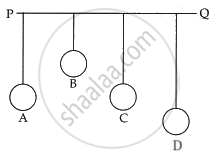
- Name the type of vibrations taking place in pendulums B and D.
- What is the state of pendulum C?
- State the reason for the type of vibrations in pendulums B and C.
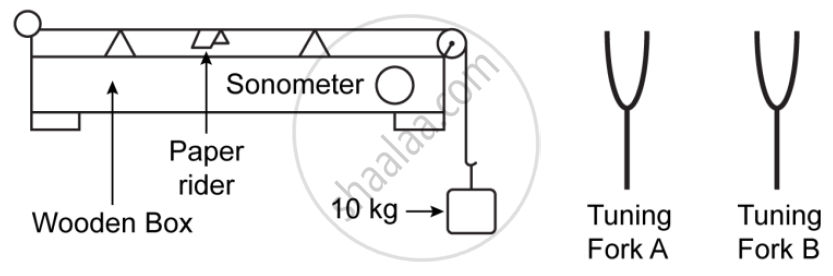
The diagram above shows a wire stretched over a sonometer. Stems of two vibrating tuning forks A and Bare touched to the wooden box of the sonometer. It is observed that the paper rider (a small piece of paper folded at the centre) present on the wire flies off when the stem of vibrating tuning fork B is touched to the wooden box but the paper just vibrates when the stem of vibrating tuning fork A is touched to the wooden box.
1) Name the phenomenon when the paper rider just vibrates.
2) Name the phenomenon when the paper rider flies off.
3) Why does the paper rider fly off when the stem of tuning fork B is touched to the box?
Give one example to illustrate forced vibrations.
Name the phenomenon involved in tuning your radio set to a particular station and define it.
The rearview mirror of a motorbike starts vibrating violently at some particular speed of the motorbike, what could be done to stop the violent vibrations.
Explain why does the rear mirror of a motorbike start Vibrating Violently, at some particular speed of motorbike?
A vibrating tuning fork is placed over the mouth of a burette filled with water. The tap is opened and the water level gradually falls. It is observed that the sound becomes the loudest for a particular length of the air column. What is the name of the phenomenon taking place when this happens? Why does the sound become the loudest?
