Advertisements
Advertisements
प्रश्न
When acoustic resonance takes place, a loud sound is heard. Why does this happen? Explain.
Advertisements
उत्तर
When acoustic resonance takes place, a loud sound is heard. This is because the natural frequency becomes equal to the frequency of externally applied force hence a loud sound is heard.
संबंधित प्रश्न
Name the phenomenon involved in tunning a radio set to a particular station.
The adjacent diagram shows three different modes of vibrations P, Q and R of the same string.
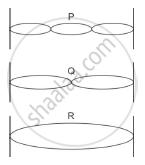
(i) Which vibration will produce a louder sound and why?
(ii) The sound of which string will have maximum shrillness?
(iii) State the ratio of wavelengths of P and R.
What are forced vibrations?
In fig. shows two tuning forks P and Q of the same frequency mounted on separate sound boxes with their open ends facing each other. The fork A is set into vibration. (i) Describe your observation. (ii) State the principle illustrated by this experiment.

In Fig. A, B, C and D are four pendulums suspended from the same elastic string XY. The lengths of pendulum A and D are equal, while the length of pendulum B is shorter and of the pendulum C is longer. Pendulum A is set into vibrations.

- What is your observation about the vibrations of pendulum D?
- Give reason for your observation in part (a).
- What type of vibrations take place in pendulums Band C?
- Give reason for the answer in part (c).
Explain a tuning fork (vibrating) is held close to ear. One hears a faint sound. The same vibrating tuning fork is placed on table, such that its handle is in contact with table, one hears a loud sound.
Explain a person walking past a railway line, in the middle of night hears a ringing sound along with the sound of his footsteps.
What are the factors that affect the frequency of a vibrating string and how do they affect the frequency?
