Advertisements
Advertisements
प्रश्न
The rearview mirror of a motorbike starts vibrating violently at some particular speed of the motorbike. What is the name of the phenomenon taking place? Why does the happen?
Advertisements
उत्तर
This phenomenon is called ‘resonance’. In this phenomenon when a body begins with the natural frequency of the others vibrating body B, then A begins to vibrate violently with the maximum amplitude.
The frame of a motorcycle along with the rearview mirror is found to vibrate violently when it is driven to a particular speed, this happens when the frame has the natural frequency of vibration equal to that of the piston when the engine is driven at that particular, speed.
संबंधित प्रश्न
Name the phenomenon involved in tunning a radio set to a particular station
The adjacent diagram shows three different modes of vibrations P, Q and R of the same string.
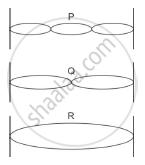
(i) Which vibration will produce a louder sound and why?
(ii) The sound of which string will have maximum shrillness?
(iii) State the ratio of wavelengths of P and R.
What are forced vibrations?
Resonance is a special case of ______ vibrations, when frequency of the driving force is ______ natural frequency of the body.
How do you tune your radio set to a particular station ? Name the phenomenon involved in doing so and define it.
When a body vibrates under a periodic force, the vibrations of the body are ______.
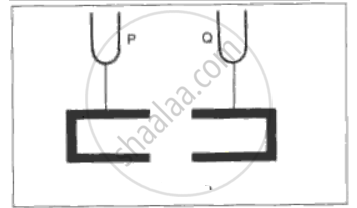
In fig. shows two tuning forks P and Q of the same frequency mounted on separate sound boxes with their open ends facing each other. The fork A is set into vibration. (i) Describe your observation. (ii) State the principle illustrated by this experiment.
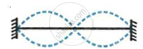
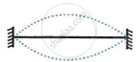
The diagram below shows three different modes of vibration P, Q and R of the same string of a given length.
 |
 |
 |
| P | Q | R |
- Which vibration will produce a louder sound and why?
- Which vibration will produce sound of maximum shrillness (or pitch) and why?
- What is the ratio of wavelength of vibrations P and R?
What do you understand by forced vibrations?
