Advertisements
Advertisements
प्रश्न
Draw the diagram of a right-angled isosceles prism which is used to make an invented image erect.
Advertisements
उत्तर

APPEARS IN
संबंधित प्रश्न
The observation made by Swarali while doing the experiment is given below. Based on these write answers to the questions:
Swarali found that the light ray travelling from the denser medium to rarer medium goes away from the normal. If the angle of incidence (i) is raised by Swarali, the angle of refraction (r) went on increasing. However, after certain value of the angle of incidence the light ray is seen to return back into the denser medium.
Questions:
- What is the specific value of∠i called?
- What is the process of reflection of incident rays into denser medium called?
- Draw the diagrams of three observations made by Swarali.
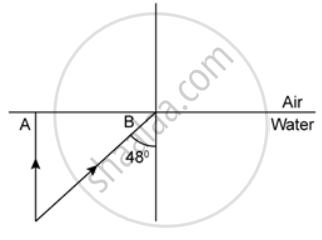
In the following figure, show two rays A and B travelling from water to air. If the critical angle for water- air surface is 48°, complete the ray diagram showing the refracted rays for each. State conditions when the ray will suffer total internal reflection.
What is meant by the statement, ‘the critical angle for diamond is 24°’?
Choose the correct option.
Consider the following phenomena/ applications: P) Mirage, Q) rainbow, R) Optical fibre and S) glittering of a diamond. Total internal reflection is involved in
Explain ‘mirage’ as an illustration of refraction.
Critical angle of light passing from glass to air is maximum for ____________.
Optical Fibres are based on the phenomenon of dispersion.
Write any two uses of total internal reflection.
When a ray of light is refracted from one medium to another, then the wavelength changes from 6000 Å to 4000 Å. The critical angle for the interface will be ______.
Total internal reflection is defined as the complete reflection of light back into an optically denser medium when:
