Advertisements
Advertisements
प्रश्न
Choose the correct option.
Consider the following phenomena/ applications: P) Mirage, Q) rainbow, R) Optical fibre and S) glittering of a diamond. Total internal reflection is involved in
पर्याय
Only R and S
Only R
Only P, R and S
all the four
Advertisements
उत्तर
Only R and S
APPEARS IN
संबंधित प्रश्न
Name the factors affecting the critical angle for the pair of media.
Which colour of light has a higher critical angle? Red light or green light.
In the given figure PQ and PR are the two light rays emerging from an object P. The ray PQ is refracted as QS.

- State the special name given to the angle of incidence ∠PQN of the ray PQ.
- What is the angle of refraction for the refracted ray QS?
- Name the phenomenon that occurs if the angle of incidence ∠PQN is increased.
- The ray PR suffers partial reflection and refraction on the water-air surface. Give reason.
- Draw in the diagram the refracted ray for the incident ray PR and hence show the position of image of the object P by the letter P’ when seen vertically from above.
Solve the previous problem if the paperweight is inverted at its place so that the spherical surface touches the paper.
Plot a graph between
Angle of incidence versus angle of reflection,
Make the correct choices for each of the following :
Total Internal reflection takes place when
(where ∠i = angle of incidence, ∠r = angle of refraction, ∠C = critical angle)
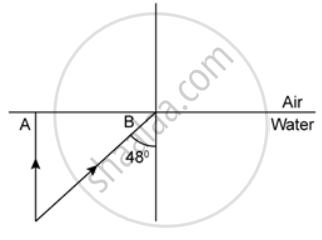
In the following figure, show two rays A and B travelling from water to air. If the critical angle for water- air surface is 48°, complete the ray diagram showing the refracted rays for each. State conditions when the ray will suffer total internal reflection.
Images formed by totally reflecting prisms are brighter than the image formed by ordinary reflected light, why?
How is the critical angle of a material related to its refractive index?
What is meant by the term ‘critical angle’?
The adjacent diagram shows two right-angled isosceles prisms A and B. Complete the diagram to show the path of rays P and Q emerging out of the prism B. What principles have you used to complete the diagram?

A spherical marble, of refractive index 1.5 and curvature 1.5 cm, contains a tiny air bubble at its centre. Where will it appear when seen from outside?
Answer the following question.
What are the advantages of optical fibre communication over electronic communication?
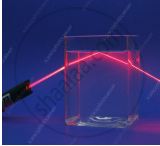
Observe the given figure and write appropriate phenomenon of light in the box.
Critical angle of light passing from glass to air is maximum for ____________.
The resultant `vec"R"` of `vec"P"` and `vec"Q"` is perpendicular to `vec"P"`. Also `|vec"P"|=|vec"R"|`. The angle between `vec"P"` and `vec"Q"` is ______.
[tan 45° = 1]
For the same angle of incidence, the angle of refraction in four media A, B, C and D are 25°, 30°, 35° and 40° respectively. The speed of light is least in medium ______.
Which one of the following is NOT the correct formula for refractive index of glass w.r.t. air (aμg) (i = angle of incidence, r = angle of refraction)
The angle of minimum deviation produced by a thin glass prism in air is 'δ'. If that prism is immersed in water, the angle of minimum deviation will be ______.
( aμg = refractive index of glass w.r.t, air aμw = refractive index of water w.r.t. air)
The twinkling effect of star light is due to ______.
A bundle of glass threads, each of which is capable of transmitting messages using light waves is called ______.
What are the conditions to achieve total internal reflection?
Write any two uses of total internal reflection.
Small air bubbles rising up a fish tank appear silvery when viewed from some particular angle is due to the ______.
When a ray of light is refracted from one medium to another, then the wavelength changes from 6000 Å to 4000 Å. The critical angle for the interface will be ______.
The formation of a mirage is explained using:
