Advertisements
Advertisements
प्रश्न
In the given figure PQ and PR are the two light rays emerging from an object P. The ray PQ is refracted as QS.

- State the special name given to the angle of incidence ∠PQN of the ray PQ.
- What is the angle of refraction for the refracted ray QS?
- Name the phenomenon that occurs if the angle of incidence ∠PQN is increased.
- The ray PR suffers partial reflection and refraction on the water-air surface. Give reason.
- Draw in the diagram the refracted ray for the incident ray PR and hence show the position of image of the object P by the letter P’ when seen vertically from above.
Advertisements
उत्तर
- ∠PQN Critical angle

- Angle of refraction is 90°.
- The phenomenon is total internal reflection.
-
Because the ray PR's angle of incidence is smaller than ∠PQN (i.e., the critical angle), the ray PR experiences partial reflection and refraction on the water-air surface.

APPEARS IN
संबंधित प्रश्न
Calculate the speed of light in a medium whose critical angle is 30° ?
Plot a graph between
Angle of incidence versus angle of refraction.
Name the factors affecting the critical angle for the pair of media.
Describe the construction and working of an optical fibre.
Answer the following question.
What are the advantages of optical fibre communication over electronic communication?
Observe the given figure and write appropriate phenomenon of light in the box.
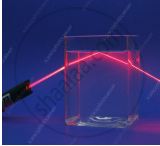
Critical angle of light passing from glass to air is maximum for ____________.
A Rainbow is a beautiful natural phenomenon formed because of the following:
Which of the following is used in optical fibres?
When the angle of incidence for light going from a denser medium to a rarer medium is exactly equal to the critical angle, the result is:
