Advertisements
Advertisements
प्रश्न
Describe the construction and working of an optical fibre.
Advertisements
उत्तर
Construction:
- An optical fibre consists of an extremely thin, transparent, and flexible core surrounded by an optically rarer flexible cover called cladding.
- For protection, the whole system is coated by a buffer and a jacket
- The entire thickness of the fibre is less than half an mm.
- Many such fibres can be packed together in an outer cover.

Construction of Optical fiber
Working:
- Working of optical fibre is based on the principle of total internal reflection.
- An optical signal (a ray of light) entering the core suffers multiple total internal reflections before emerging out after several kilometres.
- The optical signal travels with the highest possible speed in the material.
- The emerged optical signal has an extremely low loss in signal strength.
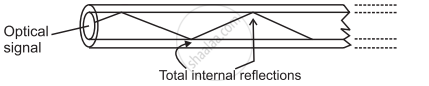
Working of Optical fibre
APPEARS IN
संबंधित प्रश्न
You are given prisms made of crown glass and flint glass with a wide variety of angles. Suggest a combination of prisms which will
(a) deviate a pencil of white light without much dispersion,
(b) disperse (and displace) a pencil of white light without much deviation.
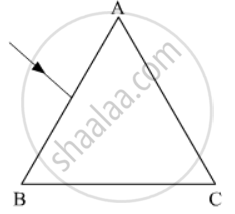
The figure shows a ray of light falling normally on the face AB of an equilateral glass prism having refractive index`3/2`, placed in water of refractive index `4/3`.Will this ray suffer total internal reflection on striking the face AC? Justify your answer.
What do you understand by the deviation produced by a prism? Why is it caused?
Name two factors which affect the critical angle for a given pair of media. State how do the factors affect it.
In the given figure PQ and PR are the two light rays emerging from an object P. The ray PQ is refracted as QS.

- State the special name given to the angle of incidence ∠PQN of the ray PQ.
- What is the angle of refraction for the refracted ray QS?
- Name the phenomenon that occurs if the angle of incidence ∠PQN is increased.
- The ray PR suffers partial reflection and refraction on the water-air surface. Give reason.
- Draw in the diagram the refracted ray for the incident ray PR and hence show the position of image of the object P by the letter P’ when seen vertically from above.
Total internal reflection can take place only if ______.
(i) Define critical angle.
(ii) State one important factor which affects the critical angle of a given medium.
Define critical angle for a given medium.
Name the principle on the basis of which optical fibres work.
State one factor on which a critical angle for a given pair of media depends. The critical angle for the glass-air interface is 45° for the yellow light. Will it be equal to, less than or greater than 45° for (i) red light, (ii) blue light?
A ray of light passes through a right-angled prism as shown in the figure. State the angles of incidence at the faces AC and BC.
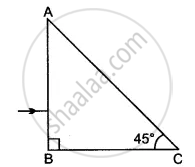
Complete the following diagram to show the path of the ray of a single colour in the diagram as if enters in and emerges out of the prism. Mark the angles wherever necessary. (Critical angle for glass = 42°).

A spherical marble, of refractive index 1.5 and curvature 1.5 cm, contains a tiny air bubble at its centre. Where will it appear when seen from outside?
Choose the correct option.
Select the WRONG statement.
Answer the following question.
Define the critical angle of incidence and obtain an expression for it.
Answer the following question.
Why is prism binoculars preferred over traditional binoculars? Describe its working in brief.
Solve Numerical example.
A monochromatic ray of light is incident at 37° on an equilateral prism of refractive index 3/2. Determine angle of emergence and angle of deviation. If angle of prism is adjustable, what should its value be for emergent rays to be just possible for the same angle of incidence?
Solve Numerical example.
From the given data set, determine angular dispersion by the prism and dispersive power of its material for extreme colours. nR = 1.62 nV = 1.66, δR = 3.1°
Which one of the following is NOT the correct formula for refractive index of glass w.r.t. air (aμg) (i = angle of incidence, r = angle of refraction)
A bundle of glass threads, each of which is capable of transmitting messages using light waves is called ______.
What is the phenomenon used in optical fiber? Explain.
A ray of light incident at an angle θ on a refracting face of a prism emerges from the other face normally. If the angle of the prism is 5° and the prism is made of a material of refractive index 1.5, the angle of incidence is ______.
Observe the given figure of the raindrop and answer the following questions:
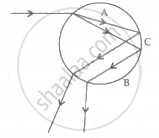
- Label A and B of the given diagram. Why colour will deviate most.
- Name the phenomenon shown in label C.
The angle made by incident ray of light with normal of the reflecting surface is called ______.
Find the value of θ in the given figure.
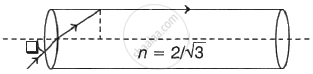
When the angle of incidence for light going from a denser medium to a rarer medium is exactly equal to the critical angle, the result is:
The formation of a mirage is explained using:
