Advertisements
Advertisements
प्रश्न
Describe the construction and working of an optical fibre.
Advertisements
उत्तर
Construction:
- An optical fibre consists of an extremely thin, transparent, and flexible core surrounded by an optically rarer flexible cover called cladding.
- For protection, the whole system is coated by a buffer and a jacket
- The entire thickness of the fibre is less than half an mm.
- Many such fibres can be packed together in an outer cover.

Construction of Optical fiber
Working:
- Working of optical fibre is based on the principle of total internal reflection.
- An optical signal (a ray of light) entering the core suffers multiple total internal reflections before emerging out after several kilometres.
- The optical signal travels with the highest possible speed in the material.
- The emerged optical signal has an extremely low loss in signal strength.
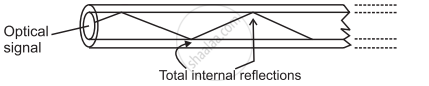
Working of Optical fibre
APPEARS IN
संबंधित प्रश्न
The diagram below shows a point source P inside a water container. Four rays A, B, C, D starting from the source P, are shown up to the water surface.
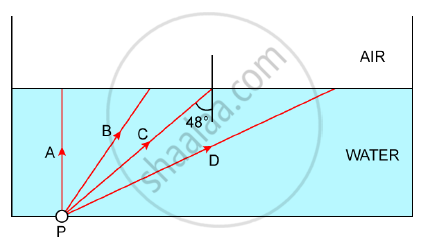
- Show in the diagram the path of these rays after striking the water surface. The Critical Angle for the water-air surface is 48°.
- Name the phenomenon which the rays B and D exhibit.
State the relation between the critical angle and the absolute refractive index of a medium.
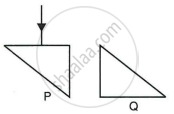
Two isosceles right-angle glass prisms P and Q are placed near each other as shown in Fig. Complete the path of the light ray entering the prism P till it emerges out of the prism Q.
Calculate the speed of light in a medium whose critical angle is 30° ?
The diagram below shows a light source P embedded in a rectangular glass block ABCD of critical angle 42°. Complete the path of the ray PQ till it emerges out of the block. [Write necessary angles].

If a light ray does not undergo, refraction at the boundary between two media, the angle of incidence is:
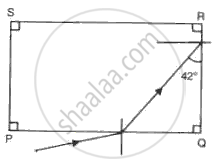
(a) A ray of monochromatic light enters glass PQRS as shown in the fig. Complete the path of ray till it emerges from the glass. (Critical angle of glass is 420).
(b) Draw diagram of a prism periscope.
(c) What are the advantages of total internal reflecting prism over plane mirror?
Name the principle on the basis of which optical fibres work.
Why do diamonds sparkle?
Express the refractive index μ of a medium in terms of the angle of incidence i in air and the angle of refraction r in a denser medium.
State two advantages of using a right-angle prism as a reflector, rather than a plane mirror.
Name the factors affecting the critical angle for the pair of media.
What is meant by the term ‘critical angle’?
Choose the correct option.
Consider the following phenomena/ applications: P) Mirage, Q) rainbow, R) Optical fibre and S) glittering of a diamond. Total internal reflection is involved in
For the same angle of incidence, the angle of refraction in four media A, B, C and D are 25°, 30°, 35° and 40° respectively. The speed of light is least in medium ______.
For a ray of light, the critical angle is minimum when it travels from ______.
The entire light is reflected back into the denser medium is called ______.
The critical angle is defined as the angle of incidence at which the total internal reflection starts to occur.
Optical Fibres are based on the phenomenon of dispersion.
The angle of incidence at which the angle of refraction is Q£ is called the critical angle.
What is a mirage? How does it occur?
A ray of light incident at an angle θ on a refracting face of a prism emerges from the other face normally. If the angle of the prism is 5° and the prism is made of a material of refractive index 1.5, the angle of incidence is ______.
Name any two phenomena which take place in the formation of a rainbow.
An endoscope uses optic fiber to transmit high resolution images of internal organs without loss of information. The principle of light that is used by the optic fiber is based on ______.
When a ray of light is refracted from one medium to another, then the wavelength changes from 6000 Å to 4000 Å. The critical angle for the interface will be ______.
When the angle of incidence for light travelling from a denser medium to a rarer medium is greater than the critical angle, the result is:
The formation of a mirage is explained using:
