Advertisements
Advertisements
प्रश्न
Draw diagram to illustrate the total internal reflection.
Advertisements
उत्तर
When the incidence angle is greater than the critical angle, i.e., in the case of total internal reflection.

APPEARS IN
संबंधित प्रश्न
A light ray does not bend at the boundary in passing from one medium to the other medium if the angle of incident is ______.
Write the necessary conditions for the phenomenon of total internal reflection to
occur ?
Prove the statement.
A rainbow is the combined effect of the refraction, dispersion, and total internal reflection of light.
PQ and PR are two light rays emerging from the object as shown in the figure below:

(i) What is the special name given to the angle of incidence (∠PQN) of ray PQ?
(ii) Copy the ray diagram and complete it to show the position of the image of the object P when seen obliquely from above.
(iii) Name the phenomenon that occurs if the angle of incidence ∠PQN is increased still further.
A spherical marble, of refractive index 1.5 and curvature 1.5 cm, contains a tiny air bubble at its centre. Where will it appear when seen from outside?
Answer the following question.
Define the critical angle of incidence and obtain an expression for it.
The outer concentric shell in optic fiber is called ______.
Observe the given figure of the raindrop and answer the following questions:
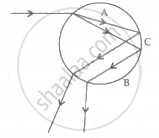
- Label A and B of the given diagram. Why colour will deviate most.
- Name the phenomenon shown in label C.
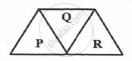
A given ray of light suffers minimum deviation in an equilateral prism P. Additional prism Q and R of identical shape and of the same material as P are now added as shown in the figure. The ray will now suffer ______.
As the angle of incidence increases for light going from a denser medium to a rarer medium, the angle of refraction:
