Advertisements
Advertisements
प्रश्न
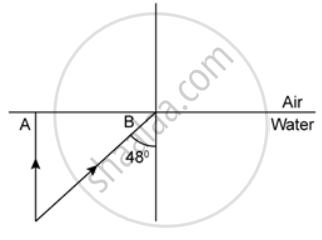
In the following figure, show two rays A and B travelling from water to air. If the critical angle for water- air surface is 48°, complete the ray diagram showing the refracted rays for each. State conditions when the ray will suffer total internal reflection.
Advertisements
उत्तर
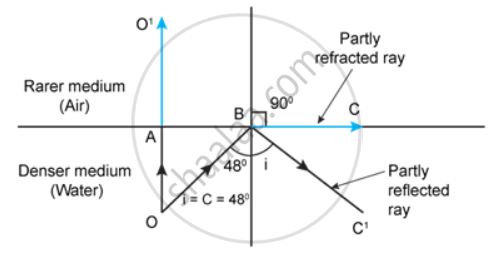
The necessary conditions for total internal reflection to occur are
- Light must travel from a denser medium to a rarer medium.
- The angle of incidence must be greater than the critical angle.
In this case, the angle of incidence. ∠ i > 48°
APPEARS IN
संबंधित प्रश्न
A ray of light travels from water to air as shown in the diagram given below :
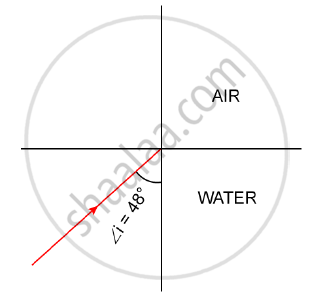
1) Copy the diagram and complete the path of the way. Given the critical angle for water is 48°.
2) State the condition so that internal reflection occurs in the above diagram.
Calculate the speed of light in a medium whose critical angle is 30° ?
Plot a graph between
Angle of incidence versus angle of refraction.
Write any two uses of total internal reflection.
What are the examples of total internal reflection in nature?
A rectangular block of glass ABCD has a refractive index 1.6. A pin is placed midway on the face AB (Figure). When observed from the face AD, the pin shall ______.

- appear to be near A.
- appear to be near D.
- appear to be at the centre of AD.
- not be seen at all.
The critical angle is the angle of incidence in the denser medium for which the angle of refraction in the rarer medium is:
When the angle of incidence for light travelling from a denser medium to a rarer medium is greater than the critical angle, the result is:
As the angle of incidence increases for light going from a denser medium to a rarer medium, the angle of refraction:
The critical angle for crown glass, which has a refractive index of 1.52, is:
