Advertisements
Advertisements
प्रश्न
A ray of light travels from water to air as shown in the diagram given below :
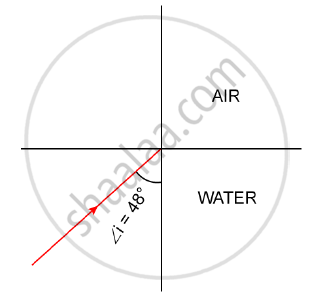
1) Copy the diagram and complete the path of the way. Given the critical angle for water is 48°.
2) State the condition so that internal reflection occurs in the above diagram.
Advertisements
उत्तर
1) The image formed by the lens is virtual and between the object and the lens. Hence, the lens used is a concave lens
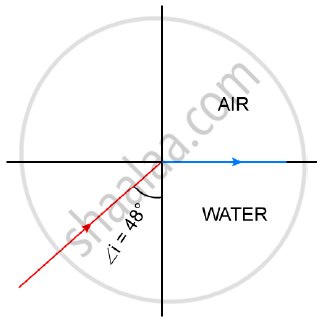
2) The condition for the occurrence of internal reflection in the above diagram is that the angle of incidence should be greater than the given critical angle for water, i.e i > 48°
APPEARS IN
संबंधित प्रश्न
State the conditions required for total internal reflection of light to take place.
Write the relation between the refractive index and critical angle for a given pair of optical media?
Total internal reflection can take place only if ______.
Solve the previous problem if the paperweight is inverted at its place so that the spherical surface touches the paper.
The diagram below shows a light source P embedded in a rectangular glass block ABCD of critical angle 42°. Complete the path of the ray PQ till it emerges out of the block. [Write necessary angles].

If a ray of light passes from medium I to medium II without any change of direction, what can be said about the refractive indices of these media (angle I is not 0)?
A ray of light is incident on a glass surface at an angle of 50° with the corresponding angle of refraction 30°. Find the value of the R.I. of glass.
The twinkling effect of star light is due to ______.
The critical angle is defined as the angle of incidence at which the total internal reflection starts to occur.
Optical Fibres are based on the phenomenon of dispersion.
