Advertisements
Advertisements
प्रश्न
If a ray of light passes from medium I to medium II without any change of direction, what can be said about the refractive indices of these media (angle I is not 0)?
A ray of light travels from one medium to another medium with no change in direction. If the angle of incidence is not zero, what can be said about the refractive indices of these media?
Advertisements
उत्तर
When a ray of light travels from medium I to medium II without any change of direction, it is possible under either of the following two conditions:
- A ray of light is incident normally on the surface separating two media.
- The refractive index of the medium I is equal to the refractive index of medium II.
APPEARS IN
संबंधित प्रश्न
How does a ray of light bend when it travels from when it is normal to the interface of the two media.
Choose the correct option.
Angles of deviation for extreme colours are given for different prisms. Select the one having maximum dispersive power of its material.
Solve Numerical example.
A monochromatic ray of light is incident at 37° on an equilateral prism of refractive index 3/2. Determine angle of emergence and angle of deviation. If angle of prism is adjustable, what should its value be for emergent rays to be just possible for the same angle of incidence?
Optical fibre communication uses the principle of ______.
A particle is projected such that the horizontal range and vertical height are equal. Then the angle of projection is :
A bundle of glass threads, each of which is capable of transmitting messages using light waves is called ______.
The angle of incidence at which the angle of refraction is Q£ is called the critical angle.
A ray of light passes through a prism of refractive index `sqrt2` as shown in the figure. Find:
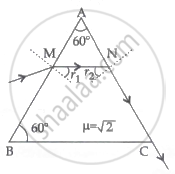
- The angle of incidence (∠r2) at face AC.
- The angle of minimum deviation for this prism.
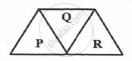
A given ray of light suffers minimum deviation in an equilateral prism P. Additional prism Q and R of identical shape and of the same material as P are now added as shown in the figure. The ray will now suffer ______.
Name any two phenomena which take place in the formation of a rainbow.
