Advertisements
Advertisements
प्रश्न
Advertisements
उत्तर
Critical angle: The angle of incidence in the denser medium for which the angle of refraction in the rarer medium is 90o.
Total internal reflection: It is an optical phenomenon that occurs when a ray of light strikes the boundary of denser medium at an angle greater than the critical angle w.r.t. the normal of the surface; this ray is then totally reflected back into the denser medium.
The two necessary conditions for total internal reflection to take place are:
1.The light ray must proceed from denser to rarer medium.
2. Angle of incidence in denser medium should be greater than the critical angle for the pair of media in contact.
APPEARS IN
संबंधित प्रश्न
Draw diagram to illustrate the total internal reflection.
Total internal reflection occurs only when a ray of light passes from a ______ medium to a ______ medium.
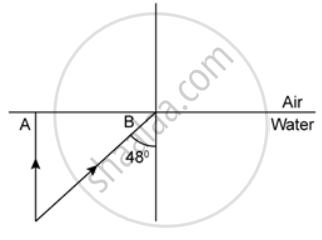
In the following figure, show two rays A and B travelling from water to air. If the critical angle for water- air surface is 48°, complete the ray diagram showing the refracted rays for each. State conditions when the ray will suffer total internal reflection.
Can light be ‘piped’ like sound in a doctor’s stethoscope?
PQ and PR are two light rays emerging from the object as shown in the figure below:

(i) What is the special name given to the angle of incidence (∠PQN) of ray PQ?
(ii) Copy the ray diagram and complete it to show the position of the image of the object P when seen obliquely from above.
(iii) Name the phenomenon that occurs if the angle of incidence ∠PQN is increased still further.
The angle of incidence at which the angle of refraction is Q£ is called the critical angle.
Which of the following is used in optical fibres?
State two differences between normal reflection and total internal reflection.
If even one of the two required conditions for total internal reflection is missing, then:
When the angle of incidence for light going from a denser medium to a rarer medium is exactly equal to the critical angle, the result is:
