Advertisements
Advertisements
प्रश्न
Explain ‘mirage’ as an illustration of refraction.
Advertisements
उत्तर
- On a hot, clear, sunny day, along a level road, there appears a pond of water ahead of the road. However, if we physically reach the spot, there is nothing but the dry road, and the water pond again appears some distance ahead. This illusion is called a mirage.
- Mirages result from the refraction of light through a non-uniform medium.
- On a hot day the air in contact with the road is hottest, and as we go up, it gets gradually cooler. The refractive index of air thus decreases with height. Hot air tends to be less optically dense than cooler air, which results in a non-uniform medium.
- Light travels in a straight line through a uniform medium but refracts when travelling through a non-uniform medium.
- Thus, the ray of light coming from the top of an object gets refracted while travelling downwards into less optically dense air and becomes more and more horizontal, as shown in the figure.

- As it almost touches the road, it bends (refracts) upward. Then onwards, upward bending continues due to denser air.
- As a result, for an observer, it appears to be coming from below, thereby giving an illusion of reflection from an (imaginary) water surface.
APPEARS IN
संबंधित प्रश्न
Name the factors affecting the critical angle for the pair of media.
Angle of deviation is the angle which the ______ ray makes with the direction of ______ray.
What is total internal reflection?
Write the necessary conditions for the phenomenon of total internal reflection to
occur ?
One day Chetan’s mother developed a severe stomach ache all of a sudden. She was rushed to the doctor who suggested for an immediate endoscopy test and gave an estimate of expenditure for the same. Chetan immediately contacted his class teacher and shared the information with her. The class teacher arranged for the money and rushed to the hospital. On realizing that Chetan belonged to a below average income group family, even the doctor offered concession for the test fee. The test was conducted successfully.
Answer the following questions based on the above information:
(a) Which principle in optics is made use of in endoscopy?
(b) Briefly explain the values reflected in the action taken by the teacher.
(c) In what way do you appreciate the response of the doctor on the given situation?
Prove the statement.
A rainbow is the combined effect of the refraction, dispersion, and total internal reflection of light.
Define critical angle for a given medium.
Plot a graph between
Angle of incidence versus angle of refraction.
Name the principle on the basis of which optical fibres work.
How does a ray of light bend when it travels from rarer to denser medium
How does a ray of light bend when it travels from when it is normal to the interface of the two media.
Can light be ‘piped’ like sound in a doctor’s stethoscope?
If a ray of light passes from medium I to medium II without any change of direction, what can be said about the refractive indices of these media (angle I is not 0)?
The diagram shows a point source P inside a water container. Three rays A, B, and C starting from P are shown up to the water surface. Show in the diagram the path of these rays after striking the water surface. The critical angle for the water-air pair is 48°.

Complete the following diagram to show the path of the ray of a single colour in the diagram as if enters in and emerges out of the prism. Mark the angles wherever necessary. (Critical angle for glass = 42°).
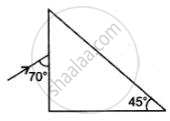
PQ and PR are two light rays emerging from the object as shown in the figure below:

(i) What is the special name given to the angle of incidence (∠PQN) of ray PQ?
(ii) Copy the ray diagram and complete it to show the position of the image of the object P when seen obliquely from above.
(iii) Name the phenomenon that occurs if the angle of incidence ∠PQN is increased still further.
A ray of light is incident as a normal ray on the surface of separation of two different mediums. What is the value of the angle of incidence in this case?
Choose the correct option.
Select the WRONG statement.
Answer the following question.
What are the advantages of optical fibre communication over electronic communication?
Which one of the following is NOT the correct formula for refractive index of glass w.r.t. air (aμg) (i = angle of incidence, r = angle of refraction)
For a ray of light, the critical angle is minimum when it travels from ______.
Total internal reflection can take place only if light is travelling from ______.
A bundle of glass threads, each of which is capable of transmitting messages using light waves is called ______.
What are the conditions to achieve total internal reflection?
Write any two uses of total internal reflection.
The phenomena involved in the reflection of radiowaves by ionosphere is similar to ______.
State the condition under which total internal reflection occurs. Give the mathematical expression for total internal reflection.
Observe the given figure of the raindrop and answer the following questions:
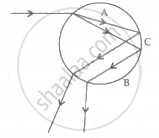
- Label A and B of the given diagram. Why colour will deviate most.
- Name the phenomenon shown in label C.
