Advertisements
Advertisements
प्रश्न
You are given prisms made of crown glass and flint glass with a wide variety of angles. Suggest a combination of prisms which will
(a) deviate a pencil of white light without much dispersion,
(b) disperse (and displace) a pencil of white light without much deviation.
Advertisements
उत्तर
(a)Place the two prisms beside each other. Make sure that their bases are on the opposite sides of the incident white light, with their faces touching each other. When the white light is incident on the first prism, it will get dispersed. When this dispersed light is incident on the second prism, it will recombine and white light will emerge from the combination of the two prisms.
(b)Take the system of the two prisms as suggested in answer (a). Adjust (increase) the angle of the flint-glass-prism so that the deviations due to the combination of the prisms become equal. This combination will disperse the pencil of white light without much deviation.
संबंधित प्रश्न
A ray of light travels from water to air as shown in the diagram given below :
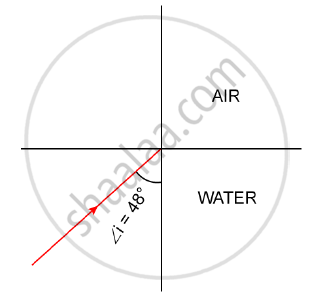
1) Copy the diagram and complete the path of the way. Given the critical angle for water is 48°.
2) State the condition so that internal reflection occurs in the above diagram.
A light ray does not bend at the boundary in passing from one medium to the other medium if the angle of incident is ______.
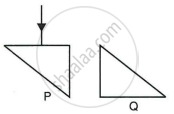
Two isosceles right-angle glass prisms P and Q are placed near each other as shown in Fig. Complete the path of the light ray entering the prism P till it emerges out of the prism Q.
Write the necessary conditions for the phenomenon of total internal reflection to
occur ?
Total internal reflection can take place only if ______.
The diagram below shows a light source P embedded in a rectangular glass block ABCD of critical angle 42°. Complete the path of the ray PQ till it emerges out of the block. [Write necessary angles].

How does a ray of light bend when it travels from denser to rarer medium.
If a ray of light passes from medium I to medium II without any change of direction, what can be said about the refractive indices of these media (angle I is not 0)?
A ray of light incident at an angle of incidence ‘i’ passes through an equilateral glass prism such that the refracted ray inside the prism is parallel to its base and emerges from the prism at an angle of emergence ‘e’.
How is the angle of emergence ‘e’ related to the angle of incidence ‘i’?
A ray of light incident at an angle of incidence ‘i’ passes through an equilateral glass prism such that the refracted ray inside the prism is parallel to its base and emerges from the prism at an angle of emergence ‘e’.
What can you say about the value of the angle of deviation in such a situation?
A ray of light is incident on a glass surface at an angle of 50° with the corresponding angle of refraction 30°. Find the value of the R.I. of glass.
Describe the construction and working of an optical fibre.
For a ray of light, the critical angle is minimum when it travels from ______.
What are the conditions to achieve total internal reflection?
What is a mirage? How does it occur?
A light is entering from one medium refractive index `("RI" =5/3)` to another medium at an angle 30°. The angle of refraction for other medium is sin-1 `(5/6)`. then the increase in angle of incidence is ______ such that the ray of light reflected back into the same medium.
Small air bubbles rising up a fish tank appear silvery when viewed from some particular angle is due to the ______.
State two differences between normal reflection and total internal reflection.
When a ray of light is refracted from one medium to another, then the wavelength changes from 6000 Å to 4000 Å. The critical angle for the interface will be ______.
