Advertisements
Advertisements
प्रश्न
You are given prisms made of crown glass and flint glass with a wide variety of angles. Suggest a combination of prisms which will
(a) deviate a pencil of white light without much dispersion,
(b) disperse (and displace) a pencil of white light without much deviation.
Advertisements
उत्तर
(a)Place the two prisms beside each other. Make sure that their bases are on the opposite sides of the incident white light, with their faces touching each other. When the white light is incident on the first prism, it will get dispersed. When this dispersed light is incident on the second prism, it will recombine and white light will emerge from the combination of the two prisms.
(b)Take the system of the two prisms as suggested in answer (a). Adjust (increase) the angle of the flint-glass-prism so that the deviations due to the combination of the prisms become equal. This combination will disperse the pencil of white light without much deviation.
संबंधित प्रश्न
State the conditions required for total internal reflection of light to take place.
A ray of light travels from water to air as shown in the diagram given below :
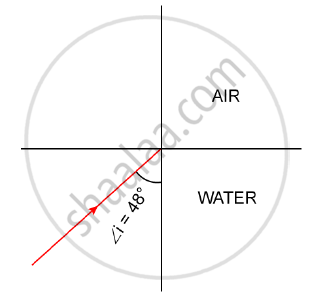
1) Copy the diagram and complete the path of the way. Given the critical angle for water is 48°.
2) State the condition so that internal reflection occurs in the above diagram.
The diagram below shows a point source P inside a water container. Four rays A, B, C, D starting from the source P, are shown up to the water surface.
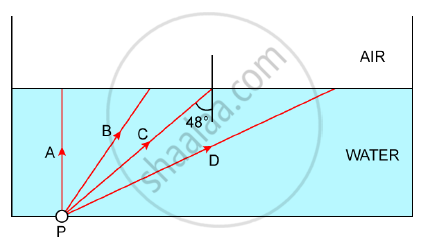
- Show in the diagram the path of these rays after striking the water surface. The Critical Angle for the water-air surface is 48°.
- Name the phenomenon which the rays B and D exhibit.
Name the factors affecting the critical angle for the pair of media.
Which colour of light has a higher critical angle? Red light or green light.
What do you understand by the deviation produced by a prism? Why is it caused?
Name two factors which affect the critical angle for a given pair of media. State how do the factors affect it.
Write the necessary conditions for the phenomenon of total internal reflection to
occur ?
How does a ray of light bend when it travels from rarer to denser medium
How does a ray of light bend when it travels from when it is normal to the interface of the two media.
How are critical angles related to the refractive index of the medium?
What is meant by the term ‘critical angle’?
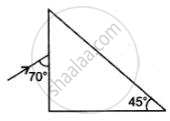
Complete the following diagram to show the path of the ray of a single colour in the diagram as if enters in and emerges out of the prism. Mark the angles wherever necessary. (Critical angle for glass = 42°).
A spherical marble, of refractive index 1.5 and curvature 1.5 cm, contains a tiny air bubble at its centre. Where will it appear when seen from outside?
The angle of minimum deviation produced by a thin glass prism in air is 'δ'. If that prism is immersed in water, the angle of minimum deviation will be ______.
( aμg = refractive index of glass w.r.t, air aμw = refractive index of water w.r.t. air)
For a ray of light, the critical angle is minimum when it travels from ______.
A particle is projected such that the horizontal range and vertical height are equal. Then the angle of projection is :
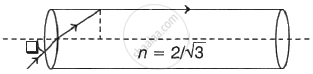
Find the value of θ in the given figure.
When a ray of light is refracted from one medium to another, then the wavelength changes from 6000 Å to 4000 Å. The critical angle for the interface will be ______.
