Advertisements
Advertisements
Question
You are given prisms made of crown glass and flint glass with a wide variety of angles. Suggest a combination of prisms which will
(a) deviate a pencil of white light without much dispersion,
(b) disperse (and displace) a pencil of white light without much deviation.
Advertisements
Solution
(a)Place the two prisms beside each other. Make sure that their bases are on the opposite sides of the incident white light, with their faces touching each other. When the white light is incident on the first prism, it will get dispersed. When this dispersed light is incident on the second prism, it will recombine and white light will emerge from the combination of the two prisms.
(b)Take the system of the two prisms as suggested in answer (a). Adjust (increase) the angle of the flint-glass-prism so that the deviations due to the combination of the prisms become equal. This combination will disperse the pencil of white light without much deviation.
RELATED QUESTIONS
State the conditions required for total internal reflection of light to take place.
Draw the diagram of a right-angled isosceles prism which is used to make an invented image erect.
One day Chetan’s mother developed a severe stomach ache all of a sudden. She was rushed to the doctor who suggested for an immediate endoscopy test and gave an estimate of expenditure for the same. Chetan immediately contacted his class teacher and shared the information with her. The class teacher arranged for the money and rushed to the hospital. On realizing that Chetan belonged to a below average income group family, even the doctor offered concession for the test fee. The test was conducted successfully.
Answer the following questions based on the above information:
(a) Which principle in optics is made use of in endoscopy?
(b) Briefly explain the values reflected in the action taken by the teacher.
(c) In what way do you appreciate the response of the doctor on the given situation?
Make the correct choices for each of the following :
Total Internal reflection takes place when
(where ∠i = angle of incidence, ∠r = angle of refraction, ∠C = critical angle)
Why do diamonds sparkle?
Images formed by totally reflecting prisms are brighter than the image formed by ordinary reflected light, why?
Choose the correct option.
Select the WRONG statement.
Explain ‘mirage’ as an illustration of refraction.
Answer the following question.
Under what conditions are total internal reflection possible? Explain it with a suitable example.
Answer the following question.
Why is prism binoculars preferred over traditional binoculars? Describe its working in brief.
Solve Numerical example.
A monochromatic ray of light is incident at 37° on an equilateral prism of refractive index 3/2. Determine angle of emergence and angle of deviation. If angle of prism is adjustable, what should its value be for emergent rays to be just possible for the same angle of incidence?
The angle of minimum deviation produced by a thin glass prism in air is 'δ'. If that prism is immersed in water, the angle of minimum deviation will be ______.
( aμg = refractive index of glass w.r.t, air aμw = refractive index of water w.r.t. air)
The phenomena involved in the reflection of radiowaves by ionosphere is similar to ______.
A Rainbow is a beautiful natural phenomenon formed because of the following:
Observe the given figure of the raindrop and answer the following questions:
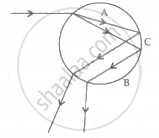
- Label A and B of the given diagram. Why colour will deviate most.
- Name the phenomenon shown in label C.
Which of the following is used in optical fibres?
The angle made by incident ray of light with normal of the reflecting surface is called ______.
Name any two phenomena which take place in the formation of a rainbow.
