Advertisements
Advertisements
Question
Choose the correct option.
Angles of deviation for extreme colours are given for different prisms. Select the one having maximum dispersive power of its material.
Options
7°, 10°
8°, 11°
12°, 16°
10°, 14°
Advertisements
Solution
7°, 10°
Explanation:
Dispersive power for thin prism is,
ω = `(δ_"V"-δ_"R")/(((δ_"V"+δ_"R")/2)`
∴ For values in option (A),
ω = `(10-7)/(((10+7)/2))=6/17` = 0.35
For values in option (B),
ω = `(11-8)/(((11+8)/2))=6/19` = 0.31
For values in option (C),
ω = `(16-12)/(((16+12)/2))=2/7` = 0.28
For values in option (D),
ω = `(14-10)/(((14+10)/2))=1/3` = 0.33
Thus, value of ω is maximum for prism with angles of deviations, 7°, 10°.
APPEARS IN
RELATED QUESTIONS
The diagram below shows a point source P inside a water container. Four rays A, B, C, D starting from the source P, are shown up to the water surface.
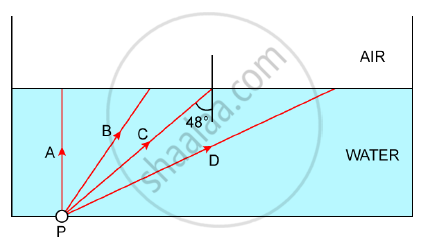
- Show in the diagram the path of these rays after striking the water surface. The Critical Angle for the water-air surface is 48°.
- Name the phenomenon which the rays B and D exhibit.
Which colour of light has a higher critical angle? Red light or green light.
Total internal reflection occurs only when a ray of light passes from a ______ medium to a ______ medium.
Calculate the speed of light in a medium whose critical angle is 30° ?
Swarali has got the following observations while doing an experiment. Answer her questions with the help of observations.
Swarali observed that the light bent away from the normal, while travelling from dense medium to rarer medium. When Swarali increased the values of angle of incidence (i), the values of angle of refraction (r) went on increasing. But at a certain angle of incidence, the light rays returned into the dense medium.
So, Swarali has some questions. Answer them –
a) Name this certain value of ‘i ’. What is the value of ‘r’ at that time ?
b) Name this process of returning of light in dense medium. Explain the process.
Total internal reflection can take place only if ______.
Solve the previous problem if the paperweight is inverted at its place so that the spherical surface touches the paper.
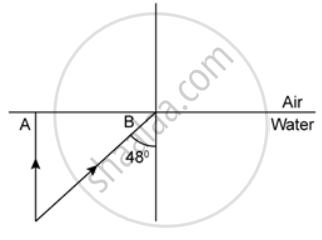
In the following figure, show two rays A and B travelling from water to air. If the critical angle for water- air surface is 48°, complete the ray diagram showing the refracted rays for each. State conditions when the ray will suffer total internal reflection.
Name the principle on the basis of which optical fibres work.
How does a ray of light bend when it travels from rarer to denser medium
Write down the relationship between the critical angle and the refractive index of the medium.
Express the refractive index μ of a medium in terms of the angle of incidence i in air and the angle of refraction r in a denser medium.
Images formed by totally reflecting prisms are brighter than the image formed by ordinary reflected light, why?
Name the factors affecting the critical angle for the pair of media.
The adjacent diagram shows two right-angled isosceles prisms A and B. Complete the diagram to show the path of rays P and Q emerging out of the prism B. What principles have you used to complete the diagram?

Choose the correct option.
Consider the following phenomena/ applications: P) Mirage, Q) rainbow, R) Optical fibre and S) glittering of a diamond. Total internal reflection is involved in
A spherical marble, of refractive index 1.5 and curvature 1.5 cm, contains a tiny air bubble at its centre. Where will it appear when seen from outside?
Choose the correct option.
Select the WRONG statement.
Answer the following question.
Under what conditions are total internal reflection possible? Explain it with a suitable example.
Describe the construction and working of an optical fibre.
Solve Numerical example.
A monochromatic ray of light is incident at 37° on an equilateral prism of refractive index 3/2. Determine angle of emergence and angle of deviation. If angle of prism is adjustable, what should its value be for emergent rays to be just possible for the same angle of incidence?
The twinkling effect of star light is due to ______.
A ray of light passes through a prism of refractive index `sqrt2` as shown in the figure. Find:
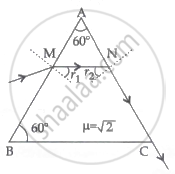
- The angle of incidence (∠r2) at face AC.
- The angle of minimum deviation for this prism.
- Assertion (A): Propagation of light through an optical fibre is due to total internal reflection taking place at the core-cladding interface.
- Reason (R): Refractive index of the material of the cladding of the optical fibre is greater than that of the core.
The diagram below shows a fish in the tank and its image seen on the surface of the water.
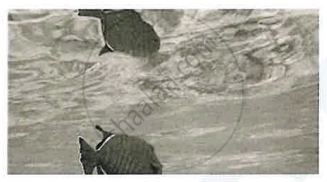
Name the phenomenon responsible for the formation of this image.
Total internal reflection is defined as the complete reflection of light back into an optically denser medium when:
As the angle of incidence increases for light going from a denser medium to a rarer medium, the angle of refraction:
The critical angle for water, which has a refractive index of 1.33, is:
