Advertisements
Advertisements
Question
Make the correct choices for each of the following :
Total Internal reflection takes place when
(where ∠i = angle of incidence, ∠r = angle of refraction, ∠C = critical angle)
Options
Light is going from glass to air and ∠I < ∠C
Light is going from air to glss and ∠i < ∠C
Light is going from glass to air and ∠i > ∠C
Light is going from air to glss and ∠i > ∠C
Light is going from glass to air and ∠i = ∠r
Advertisements
Solution
Light is going from glass to air and ∠i > ∠C
APPEARS IN
RELATED QUESTIONS
A ray of light travels from water to air as shown in the diagram given below :
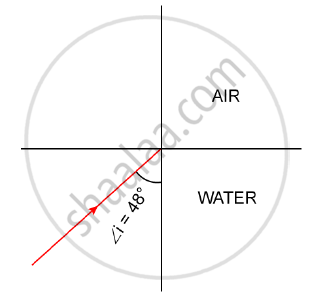
1) Copy the diagram and complete the path of the way. Given the critical angle for water is 48°.
2) State the condition so that internal reflection occurs in the above diagram.
Angle of deviation is the angle which the ______ ray makes with the direction of ______ray.
If a ray of light passes from medium I to medium II without any change of direction, what can be said about the refractive indices of these media (angle I is not 0)?
Complete the following diagram to show the path of the ray of a single colour in the diagram as if enters in and emerges out of the prism. Mark the angles wherever necessary. (Critical angle for glass = 42°).

Answer the following question.
Define the critical angle of incidence and obtain an expression for it.
A green light is incident from the water to the air-water interface at the critical angle (C). Select the correct statement.
A green light is incident from the water to the air-water interface at the critical angle (θ). Select the correct statement.
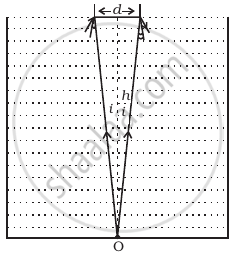
A jar of height h is filled with a transparent liquid of refractive index µ (Figure). At the centre of the jar on the bottom surface is a dot. Find the minimum diameter of a disc, such that when placed on the top surface symmetrically about the centre, the dot is invisible.
Small air bubbles rising up a fish tank appear silvery when viewed from some particular angle is due to the ______.
The critical angle for water, which has a refractive index of 1.33, is:
