Advertisements
Advertisements
Question
Angle of deviation is the angle which the ______ ray makes with the direction of ______ray.
Advertisements
Solution
Angle of deviation is the angle which the emergent ray makes with the direction of incident ray.
APPEARS IN
RELATED QUESTIONS
What is total internal reflection?
Plot a graph between
Angle of incidence versus angle of refraction.
(a) A ray of monochromatic light enters glass PQRS as shown in the fig. Complete the path of ray till it emerges from the glass. (Critical angle of glass is 420).
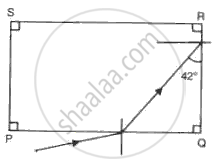
(b) Draw diagram of a prism periscope.
(c) What are the advantages of total internal reflecting prism over plane mirror?
How does a ray of light bend when it travels from when it is normal to the interface of the two media.
Write down the relationship between the critical angle and the refractive index of the medium.
Draw a diagram, properly labelled, to illustrate the use of a total reflecting prism (a right-angled isosceles prism) to turn a ray of light through 180°. Name an instrument in which this device is used.
Solve Numerical example.
From the given data set, determine angular dispersion by the prism and dispersive power of its material for extreme colours. nR = 1.62 nV = 1.66, δR = 3.1°
Optical Fibres are based on the phenomenon of dispersion.
A jar of height h is filled with a transparent liquid of refractive index µ (Figure). At the centre of the jar on the bottom surface is a dot. Find the minimum diameter of a disc, such that when placed on the top surface symmetrically about the centre, the dot is invisible.
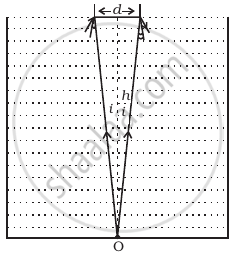
When the angle of incidence for light going from a denser medium to a rarer medium is exactly equal to the critical angle, the result is:
