Advertisements
Advertisements
Question
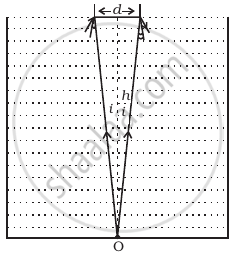
A jar of height h is filled with a transparent liquid of refractive index µ (Figure). At the centre of the jar on the bottom surface is a dot. Find the minimum diameter of a disc, such that when placed on the top surface symmetrically about the centre, the dot is invisible.
Advertisements
Solution
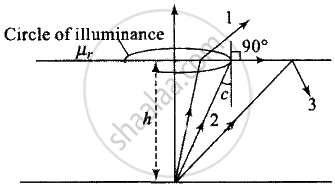
In the figure, ray 1 strikes the surface at an angle less than critical angle c and gets refracted in rear medium. Ray 2 strikes the surface making an angle greater than the critical angle and gets internally reflected. The locus of points where ray strikes at critical angle is a circle called circle of illuminance (C.O.I). All light rays striking inside the circle of illuminance get refracted in the rarer medium. If an observer is in the rear medium, he/she will see light coming out only from within the circle of illuminance. If a circular opaque plate covers the circle of illuminance, no light will get refracted in the rarer medium and then the object cannot be seen from the rarer medium.
In figure, O is a small dot at the bottom of the jar. The ray from the dot emerges out of a circular patch of water surface of diameter AB till the angle of incidence for the rays OA and OB exceeds the critical angle (iC).
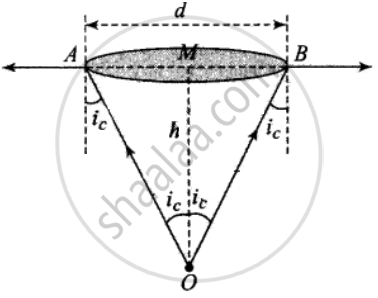
Rays of light incident at an angle greater than iC, are totally reflected within the water and consequently cannot emerge out of the water surface.
As `sin i_C = 1/mu` ⇒ `tan i_C = 1/sqrt(mu^2 - 1)`
Now, `(d/2)/h = tan i_c`
⇒ `d/2 = h tan i_c = h 1/sqrt(mu^2 - 1)`
⇒ `d = (2h)/sqrt(mu^2 - 1)`
This is the required expression of d.
APPEARS IN
RELATED QUESTIONS
State the conditions required for total internal reflection of light to take place.
Name the factors affecting the critical angle for the pair of media.
Name two factors which affect the critical angle for a given pair of media. State how do the factors affect it.
State two conditions necessary for total internal reflection to occur.
Total internal reflection occurs only when a ray of light passes from a ______ medium to a ______ medium.
Calculate the speed of light in a medium whose critical angle is 30° ?
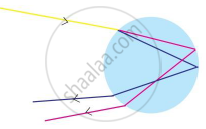
i) Observe the given figure and answer the following questions.
a) Identify and write the natural process shown in the figure.
b) List the phenomena which are observe in this process.
c) Redraw the diagram and show above phenomena in it.
The observation made by Swarali while doing the experiment is given below. Based on these write answers to the questions:
Swarali found that the light ray travelling from the denser medium to rarer medium goes away from the normal. If the angle of incidence (i) is raised by Swarali, the angle of refraction (r) went on increasing. However, after certain value of the angle of incidence the light ray is seen to return back into the denser medium.
Questions:
- What is the specific value of∠i called?
- What is the process of reflection of incident rays into denser medium called?
- Draw the diagrams of three observations made by Swarali.
Why do diamonds sparkle?
If a ray of light passes from medium I to medium II without any change of direction, what can be said about the refractive indices of these media (angle I is not 0)?
Choose the correct option.
Select the WRONG statement.
Choose the correct option.
Angles of deviation for extreme colours are given for different prisms. Select the one having maximum dispersive power of its material.
Answer the following question.
Under what conditions are total internal reflection possible? Explain it with a suitable example.
Solve Numerical example.
From the given data set, determine angular dispersion by the prism and dispersive power of its material for extreme colours. nR = 1.62 nV = 1.66, δR = 3.1°
The resultant `vec"R"` of `vec"P"` and `vec"Q"` is perpendicular to `vec"P"`. Also `|vec"P"|=|vec"R"|`. The angle between `vec"P"` and `vec"Q"` is ______.
[tan 45° = 1]
Optical fibre communication uses the principle of ______.
Which of the following is used in optical fibres?
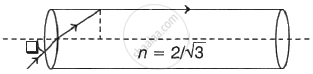
Find the value of θ in the given figure.
An endoscope uses optic fiber to transmit high resolution images of internal organs without loss of information. The principle of light that is used by the optic fiber is based on ______.
