Advertisements
Advertisements
प्रश्न
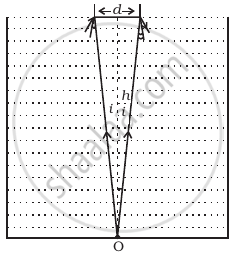
A jar of height h is filled with a transparent liquid of refractive index µ (Figure). At the centre of the jar on the bottom surface is a dot. Find the minimum diameter of a disc, such that when placed on the top surface symmetrically about the centre, the dot is invisible.
Advertisements
उत्तर
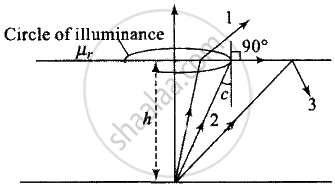
In the figure, ray 1 strikes the surface at an angle less than critical angle c and gets refracted in rear medium. Ray 2 strikes the surface making an angle greater than the critical angle and gets internally reflected. The locus of points where ray strikes at critical angle is a circle called circle of illuminance (C.O.I). All light rays striking inside the circle of illuminance get refracted in the rarer medium. If an observer is in the rear medium, he/she will see light coming out only from within the circle of illuminance. If a circular opaque plate covers the circle of illuminance, no light will get refracted in the rarer medium and then the object cannot be seen from the rarer medium.
In figure, O is a small dot at the bottom of the jar. The ray from the dot emerges out of a circular patch of water surface of diameter AB till the angle of incidence for the rays OA and OB exceeds the critical angle (iC).
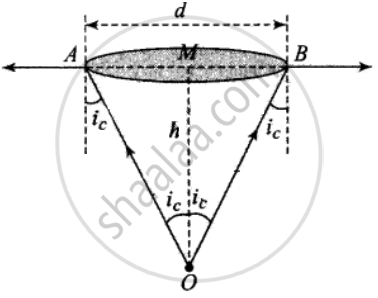
Rays of light incident at an angle greater than iC, are totally reflected within the water and consequently cannot emerge out of the water surface.
As `sin i_C = 1/mu` ⇒ `tan i_C = 1/sqrt(mu^2 - 1)`
Now, `(d/2)/h = tan i_c`
⇒ `d/2 = h tan i_c = h 1/sqrt(mu^2 - 1)`
⇒ `d = (2h)/sqrt(mu^2 - 1)`
This is the required expression of d.
APPEARS IN
संबंधित प्रश्न
State the conditions required for total internal reflection of light to take place.
Draw diagram to illustrate the total internal reflection.
In the given figure PQ and PR are the two light rays emerging from an object P. The ray PQ is refracted as QS.

- State the special name given to the angle of incidence ∠PQN of the ray PQ.
- What is the angle of refraction for the refracted ray QS?
- Name the phenomenon that occurs if the angle of incidence ∠PQN is increased.
- The ray PR suffers partial reflection and refraction on the water-air surface. Give reason.
- Draw in the diagram the refracted ray for the incident ray PR and hence show the position of image of the object P by the letter P’ when seen vertically from above.
Prove the statement.
A rainbow is the combined effect of the refraction, dispersion, and total internal reflection of light.
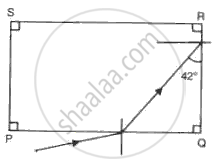
(a) A ray of monochromatic light enters glass PQRS as shown in the fig. Complete the path of ray till it emerges from the glass. (Critical angle of glass is 420).
(b) Draw diagram of a prism periscope.
(c) What are the advantages of total internal reflecting prism over plane mirror?
How does a ray of light bend when it travels from rarer to denser medium
A ray of light incident at an angle of incidence ‘i’ passes through an equilateral glass prism such that the refracted ray inside the prism is parallel to its base and emerges from the prism at an angle of emergence ‘e’.
How is the angle of emergence ‘e’ related to the angle of incidence ‘i’?
How is the critical angle of a material related to its refractive index?
What is meant by the term ‘critical angle’?
A ray of light passes through a right-angled prism as shown in the figure. State the angles of incidence at the faces AC and BC.
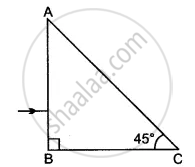
The adjacent diagram shows two right-angled isosceles prisms A and B. Complete the diagram to show the path of rays P and Q emerging out of the prism B. What principles have you used to complete the diagram?

The angle of minimum deviation produced by a thin glass prism in air is 'δ'. If that prism is immersed in water, the angle of minimum deviation will be ______.
( aμg = refractive index of glass w.r.t, air aμw = refractive index of water w.r.t. air)
For a ray of light, the critical angle is minimum when it travels from ______.
Optical fibre communication uses the principle of ______.
The phenomena involved in the reflection of radiowaves by ionosphere is similar to ______.
Small air bubbles rising up a fish tank appear silvery when viewed from some particular angle is due to the ______.
Total internal reflection is defined as the complete reflection of light back into an optically denser medium when:
When the angle of incidence for light going from a denser medium to a rarer medium is exactly equal to the critical angle, the result is:
The formation of a mirage is explained using:
