Advertisements
Advertisements
प्रश्न
State two conditions necessary for total internal reflection to occur.
Write the two conditions for total internal reflection of light.
State the conditions required for total internal reflection of light to take place.
State the two conditions under which total internal reflection occurs.
Advertisements
उत्तर
- The light must travel from a denser medium to a rarer medium.
- The angle of incidence must be greater than the critical angle for the pair of media.
APPEARS IN
संबंधित प्रश्न
Angle of deviation is the angle which the ______ ray makes with the direction of ______ray.
Two isosceles right-angle glass prisms P and Q are placed near each other as shown in Fig. Complete the path of the light ray entering the prism P till it emerges out of the prism Q.
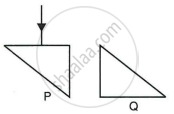
Prove the statement.
A rainbow is the combined effect of the refraction, dispersion, and total internal reflection of light.
Plot a graph between
Sine of angle of incidence versus sine of angle of refraction,
If a light ray does not undergo, refraction at the boundary between two media, the angle of incidence is:
Images formed by totally reflecting prisms are brighter than the image formed by ordinary reflected light, why?
How is the critical angle of a material related to its refractive index?
Draw a diagram, properly labelled, to illustrate the use of a total reflecting prism (a right-angled isosceles prism) to turn a ray of light through 180°. Name an instrument in which this device is used.
A ray of light is incident on a glass surface at an angle of 50° with the corresponding angle of refraction 30°. Find the value of the R.I. of glass.
A ray of light is incident as a normal ray on the surface of separation of two different mediums. What is the value of the angle of incidence in this case?
Solve Numerical example.
From the given data set, determine angular dispersion by the prism and dispersive power of its material for extreme colours. nR = 1.62 nV = 1.66, δR = 3.1°
Observe the given figure and write appropriate phenomenon of light in the box.
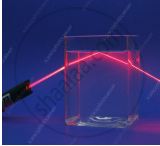
Optical fibre communication uses the principle of ______.
The entire light is reflected back into the denser medium is called ______.
The phenomena involved in the reflection of radiowaves by ionosphere is similar to ______.
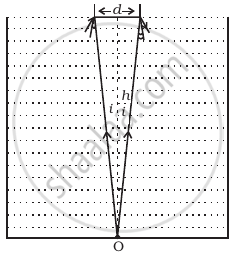
A jar of height h is filled with a transparent liquid of refractive index µ (Figure). At the centre of the jar on the bottom surface is a dot. Find the minimum diameter of a disc, such that when placed on the top surface symmetrically about the centre, the dot is invisible.
A light is entering from one medium refractive index `("RI" =5/3)` to another medium at an angle 30°. The angle of refraction for other medium is sin-1 `(5/6)`. then the increase in angle of incidence is ______ such that the ray of light reflected back into the same medium.
A ray of light passes from vacuum into a medium of refractive index µ, the angle of incidence is found to be twice the angle of refraction. Then the angle of incidence is ______.
The angle made by incident ray of light with normal of the reflecting surface is called ______.
- Assertion (A): Propagation of light through an optical fibre is due to total internal reflection taking place at the core-cladding interface.
- Reason (R): Refractive index of the material of the cladding of the optical fibre is greater than that of the core.
When a ray of light is refracted from one medium to another, then the wavelength changes from 6000 Å to 4000 Å. The critical angle for the interface will be ______.
The critical angle is the angle of incidence in the denser medium for which the angle of refraction in the rarer medium is:
When the angle of incidence for light going from a denser medium to a rarer medium is exactly equal to the critical angle, the result is:
As the angle of incidence increases for light going from a denser medium to a rarer medium, the angle of refraction:
The critical angle for water, which has a refractive index of 1.33, is:
The formation of a mirage is explained using:
