Advertisements
Advertisements
Questions
State two conditions necessary for total internal reflection to occur.
Write the two conditions for total internal reflection of light.
State the conditions required for total internal reflection of light to take place.
State the two conditions under which total internal reflection occurs.
Advertisements
Solution
- The light must travel from a denser medium to a rarer medium.
- The angle of incidence must be greater than the critical angle for the pair of media.
APPEARS IN
RELATED QUESTIONS
State the conditions required for total internal reflection of light to take place.
Name the factors affecting the critical angle for the pair of media.
A light ray does not bend at the boundary in passing from one medium to the other medium if the angle of incident is ______.
Write the necessary conditions for the phenomenon of total internal reflection to
occur ?
Calculate the speed of light in a medium whose critical angle is 30° ?
Solve the previous problem if the paperweight is inverted at its place so that the spherical surface touches the paper.
(a) A ray of monochromatic light enters glass PQRS as shown in the fig. Complete the path of ray till it emerges from the glass. (Critical angle of glass is 420).
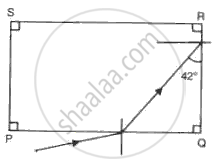
(b) Draw diagram of a prism periscope.
(c) What are the advantages of total internal reflecting prism over plane mirror?
Make the correct choices for each of the following :
Total Internal reflection takes place when
(where ∠i = angle of incidence, ∠r = angle of refraction, ∠C = critical angle)
How does a ray of light bend when it travels from when it is normal to the interface of the two media.
Why do diamonds sparkle?
A ray of light incident at an angle of incidence ‘i’ passes through an equilateral glass prism such that the refracted ray inside the prism is parallel to its base and emerges from the prism at an angle of emergence ‘e’.
How is the angle of emergence ‘e’ related to the angle of incidence ‘i’?
Draw a diagram, properly labelled, to illustrate the use of a total reflecting prism (a right-angled isosceles prism) to turn a ray of light through 180°. Name an instrument in which this device is used.
The adjacent diagram shows two right-angled isosceles prisms A and B. Complete the diagram to show the path of rays P and Q emerging out of the prism B. What principles have you used to complete the diagram?

A ray of light is incident on a glass surface at an angle of 50° with the corresponding angle of refraction 30°. Find the value of the R.I. of glass.
A spherical marble, of refractive index 1.5 and curvature 1.5 cm, contains a tiny air bubble at its centre. Where will it appear when seen from outside?
Which of the following is not involved in formation of a rainbow?
Explain ‘mirage’ as an illustration of refraction.
Answer the following question.
What are the advantages of optical fibre communication over electronic communication?
Observe the given figure and write appropriate phenomenon of light in the box.
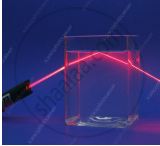
Critical angle of light passing from glass to air is maximum for ____________.
A green light is incident from the water to the air-water interface at the critical angle (C). Select the correct statement.
Which of the following statements about total internal reflection is true?
What are the examples of total internal reflection in nature?
A ray of light incident at an angle θ on a refracting face of a prism emerges from the other face normally. If the angle of the prism is 5° and the prism is made of a material of refractive index 1.5, the angle of incidence is ______.
A rectangular block of glass ABCD has a refractive index 1.6. A pin is placed midway on the face AB (Figure). When observed from the face AD, the pin shall ______.
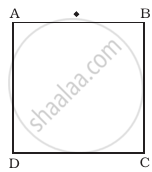
- appear to be near A.
- appear to be near D.
- appear to be at the centre of AD.
- not be seen at all.
State two differences between normal reflection and total internal reflection.
When a ray of light is refracted from one medium to another, then the wavelength changes from 6000 Å to 4000 Å. The critical angle for the interface will be ______.
The formation of a mirage is explained using:
