Advertisements
Advertisements
Question
Draw a diagram, properly labelled, to illustrate the use of a total reflecting prism (a right-angled isosceles prism) to turn a ray of light through 180°. Name an instrument in which this device is used.
Advertisements
Solution
The diagram is shown below. This device is used in binoculars.

RELATED QUESTIONS
A ray of light travels from water to air as shown in the diagram given below :
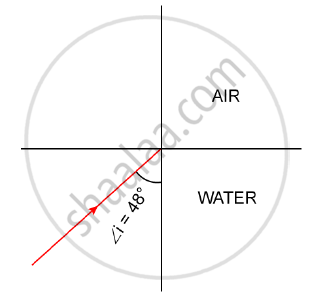
1) Copy the diagram and complete the path of the way. Given the critical angle for water is 48°.
2) State the condition so that internal reflection occurs in the above diagram.
Calculate the speed of light in a medium whose critical angle is 30° ?
Write down the relationship between the critical angle and the refractive index of the medium.
A ray of light is incident as a normal ray on the surface of separation of two different mediums. What is the value of the angle of incidence in this case?
Which of the following is not involved in formation of a rainbow?
A green light is incident from the water to the air-water interface at the critical angle (θ). Select the correct statement.
A Rainbow is a beautiful natural phenomenon formed because of the following:
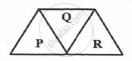
A given ray of light suffers minimum deviation in an equilateral prism P. Additional prism Q and R of identical shape and of the same material as P are now added as shown in the figure. The ray will now suffer ______.
Small air bubbles rising up a fish tank appear silvery when viewed from some particular angle is due to the ______.
State two differences between normal reflection and total internal reflection.
