Advertisements
Advertisements
Question
A spherical marble, of refractive index 1.5 and curvature 1.5 cm, contains a tiny air bubble at its centre. Where will it appear when seen from outside?
Options
1 cm inside
at the centre
`5/3` cm inside
2 cm inside
Advertisements
Solution
`bb(5/3)` cm inside
Explanation:
The refractive index of the marble is 1.5.
One can see the image formed due to the reflection in the spheres.
In order to determine the distance where the image will form, use the lens maker formula.
Hence, `mu_1/v - mu_2/u = (mu_2 - mu_1)/"R"`
Where, refractive index of air = 1, refractive index of glass = 1.5, Radius of the curvature = 1.5 cm
Substituting the values, we get,
`therefore 1/v - 1.5/0.75 = (1 - 1.5)/1.5`
`therefore 1/v - 2 = - 0.5/1.5`
`therefore 1/v - 2 = - 1/3`
`therefore 1/v = - 1/3 + 2`
`therefore 1/v = (- 1 + 6)/3`
`therefore 1/v = 5/3`
Therefore, the tiny bubble will be seen 5/3 cm inside when we see it from the outside.
APPEARS IN
RELATED QUESTIONS
Name the factors affecting the critical angle for the pair of media.
State the relation between the critical angle and the absolute refractive index of a medium.
Name two factors which affect the critical angle for a given pair of media. State how do the factors affect it.
Calculate the speed of light in a medium whose critical angle is 30° ?
Total internal reflection can take place only if ______.
(a) A ray of monochromatic light enters glass PQRS as shown in the fig. Complete the path of ray till it emerges from the glass. (Critical angle of glass is 420).
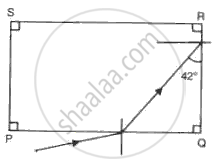
(b) Draw diagram of a prism periscope.
(c) What are the advantages of total internal reflecting prism over plane mirror?
How does a ray of light bend when it travels from denser to rarer medium.
How are critical angles related to the refractive index of the medium?
Name the factors affecting the critical angle for the pair of media.
How is the critical angle of a material related to its refractive index?
Complete the following diagram to show the path of the ray of a single colour in the diagram as if enters in and emerges out of the prism. Mark the angles wherever necessary. (Critical angle for glass = 42°).

A ray of light is incident on a glass surface at an angle of 50° with the corresponding angle of refraction 30°. Find the value of the R.I. of glass.
Choose the correct option.
Consider the following phenomena/ applications: P) Mirage, Q) rainbow, R) Optical fibre and S) glittering of a diamond. Total internal reflection is involved in
Answer the following question.
What are the advantages of optical fibre communication over electronic communication?
Solve Numerical example.
From the given data set, determine angular dispersion by the prism and dispersive power of its material for extreme colours. nR = 1.62 nV = 1.66, δR = 3.1°
A green light is incident from the water to the air-water interface at the critical angle (C). Select the correct statement.
For the same angle of incidence, the angle of refraction in four media A, B, C and D are 25°, 30°, 35° and 40° respectively. The speed of light is least in medium ______.
For a ray of light, the critical angle is minimum when it travels from ______.
Optical fibre communication uses the principle of ______.
A ray of light incident at an angle θ on a refracting face of a prism emerges from the other face normally. If the angle of the prism is 5° and the prism is made of a material of refractive index 1.5, the angle of incidence is ______.
Small air bubbles rising up a fish tank appear silvery when viewed from some particular angle is due to the ______.
Name any two phenomena which take place in the formation of a rainbow.
An endoscope uses optic fiber to transmit high resolution images of internal organs without loss of information. The principle of light that is used by the optic fiber is based on ______.
State two differences between normal reflection and total internal reflection.
The critical angle is the angle of incidence in the denser medium for which the angle of refraction in the rarer medium is:
