Advertisements
Advertisements
प्रश्न
A spherical marble, of refractive index 1.5 and curvature 1.5 cm, contains a tiny air bubble at its centre. Where will it appear when seen from outside?
पर्याय
1 cm inside
at the centre
`5/3` cm inside
2 cm inside
Advertisements
उत्तर
`bb(5/3)` cm inside
Explanation:
The refractive index of the marble is 1.5.
One can see the image formed due to the reflection in the spheres.
In order to determine the distance where the image will form, use the lens maker formula.
Hence, `mu_1/v - mu_2/u = (mu_2 - mu_1)/"R"`
Where, refractive index of air = 1, refractive index of glass = 1.5, Radius of the curvature = 1.5 cm
Substituting the values, we get,
`therefore 1/v - 1.5/0.75 = (1 - 1.5)/1.5`
`therefore 1/v - 2 = - 0.5/1.5`
`therefore 1/v - 2 = - 1/3`
`therefore 1/v = - 1/3 + 2`
`therefore 1/v = (- 1 + 6)/3`
`therefore 1/v = 5/3`
Therefore, the tiny bubble will be seen 5/3 cm inside when we see it from the outside.
APPEARS IN
संबंधित प्रश्न
A ray of light travels from water to air as shown in the diagram given below :
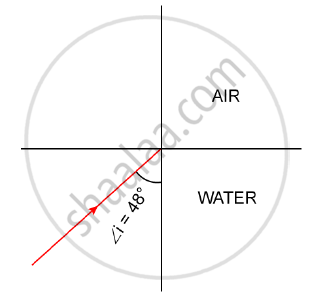
1) Copy the diagram and complete the path of the way. Given the critical angle for water is 48°.
2) State the condition so that internal reflection occurs in the above diagram.
Draw the diagram of a right-angled isosceles prism which is used to make an invented image erect.
Write the necessary conditions for the phenomenon of total internal reflection to
occur ?
One day Chetan’s mother developed a severe stomach ache all of a sudden. She was rushed to the doctor who suggested for an immediate endoscopy test and gave an estimate of expenditure for the same. Chetan immediately contacted his class teacher and shared the information with her. The class teacher arranged for the money and rushed to the hospital. On realizing that Chetan belonged to a below average income group family, even the doctor offered concession for the test fee. The test was conducted successfully.
Answer the following questions based on the above information:
(a) Which principle in optics is made use of in endoscopy?
(b) Briefly explain the values reflected in the action taken by the teacher.
(c) In what way do you appreciate the response of the doctor on the given situation?
i) Observe the given figure and answer the following questions.
a) Identify and write the natural process shown in the figure.
b) List the phenomena which are observe in this process.
c) Redraw the diagram and show above phenomena in it.
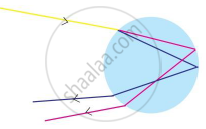
Total internal reflection can take place only if ______.
(i) Define critical angle.
(ii) State one important factor which affects the critical angle of a given medium.
Define critical angle for a given medium.
Plot a graph between
Angle of incidence versus angle of reflection,
Plot a graph between
Sine of angle of incidence versus sine of angle of refraction,
Why do diamonds sparkle?
Express the refractive index μ of a medium in terms of the angle of incidence i in air and the angle of refraction r in a denser medium.
Images formed by totally reflecting prisms are brighter than the image formed by ordinary reflected light, why?
Complete the following diagram to show the path of the ray of a single colour in the diagram as if enters in and emerges out of the prism. Mark the angles wherever necessary. (Critical angle for glass = 42°).

Answer the following question.
Under what conditions are total internal reflection possible? Explain it with a suitable example.
Which one of the following is NOT the correct formula for refractive index of glass w.r.t. air (aμg) (i = angle of incidence, r = angle of refraction)
For a ray of light, the critical angle is minimum when it travels from ______.
Optical fibre communication uses the principle of ______.
A particle is projected such that the horizontal range and vertical height are equal. Then the angle of projection is :
The entire light is reflected back into the denser medium is called ______.
Which of the following statements about total internal reflection is true?
Optical Fibres are based on the phenomenon of dispersion.
What are the examples of total internal reflection in nature?
Find the value of θ in the given figure.
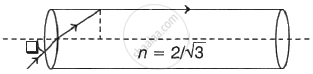
Small air bubbles rising up a fish tank appear silvery when viewed from some particular angle is due to the ______.
As the angle of incidence increases for light going from a denser medium to a rarer medium, the angle of refraction:
The critical angle for water, which has a refractive index of 1.33, is:
The formation of a mirage is explained using:
