Advertisements
Advertisements
प्रश्न
Solve the previous problem if the paperweight is inverted at its place so that the spherical surface touches the paper.
Advertisements
उत्तर
Given,
Taking the radius of the paperweight as its thickness = 3 cm
Refractive index of the paperweight (μg) = 3/2
Refractive index of the air (μ1) = 1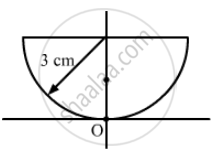
Image shift is given by:
\[∆ t = \left( 1 - \frac{1}{\mu} \right)t\]
\[ = \left( 1 - \frac{2}{3} \right)3\]
\[ = \left( \frac{1}{3} \right)3\]
\[ = 1 \text{ cm }\]
The upper surface of the paperweight is flat and the spherical spherical surface is in contact with the printed letter.
Therefore, we will take it as a simple refraction problem.
Hence, the image will appear 1 cm above point A.
APPEARS IN
संबंधित प्रश्न
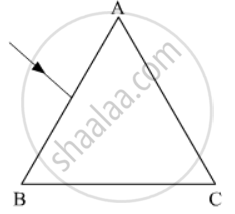
The figure shows a ray of light falling normally on the face AB of an equilateral glass prism having refractive index`3/2`, placed in water of refractive index `4/3`.Will this ray suffer total internal reflection on striking the face AC? Justify your answer.
Which colour of light has a higher critical angle? Red light or green light.
Total internal reflection occurs only when a ray of light passes from a ______ medium to a ______ medium.
Plot a graph between
Angle of incidence versus angle of reflection,
Make the correct choices for each of the following :
Total Internal reflection takes place when
(where ∠i = angle of incidence, ∠r = angle of refraction, ∠C = critical angle)
How does a ray of light bend when it travels from rarer to denser medium
Write down the relationship between the critical angle and the refractive index of the medium.
If a ray of light passes from medium I to medium II without any change of direction, what can be said about the refractive indices of these media (angle I is not 0)?
How are critical angles related to the refractive index of the medium?
A ray of light incident at an angle of incidence ‘i’ passes through an equilateral glass prism such that the refracted ray inside the prism is parallel to its base and emerges from the prism at an angle of emergence ‘e’.
How is the angle of emergence ‘e’ related to the angle of incidence ‘i’?
State one factor on which a critical angle for a given pair of media depends. The critical angle for the glass-air interface is 45° for the yellow light. Will it be equal to, less than or greater than 45° for (i) red light, (ii) blue light?
What is meant by the statement, ‘the critical angle for diamond is 24°’?
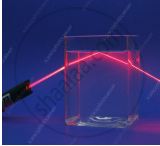
Observe the given figure and write appropriate phenomenon of light in the box.
A ray of light incident at an angle θ on a refracting face of a prism emerges from the other face normally. If the angle of the prism is 5° and the prism is made of a material of refractive index 1.5, the angle of incidence is ______.
Which of the following is used in optical fibres?
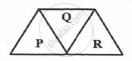
A given ray of light suffers minimum deviation in an equilateral prism P. Additional prism Q and R of identical shape and of the same material as P are now added as shown in the figure. The ray will now suffer ______.
Find the value of θ in the given figure.
When the angle of incidence for light travelling from a denser medium to a rarer medium is greater than the critical angle, the result is:
