Advertisements
Advertisements
प्रश्न
A ray of light incident at an angle of incidence ‘i’ passes through an equilateral glass prism such that the refracted ray inside the prism is parallel to its base and emerges from the prism at an angle of emergence ‘e’.
How is the angle of emergence ‘e’ related to the angle of incidence ‘i’?
Advertisements
उत्तर
Angle of emergence = angle of incidence.
संबंधित प्रश्न
State the relation between the critical angle and the absolute refractive index of a medium.
Angle of deviation is the angle which the ______ ray makes with the direction of ______ray.
The diagram below shows a light source P embedded in a rectangular glass block ABCD of critical angle 42°. Complete the path of the ray PQ till it emerges out of the block. [Write necessary angles].

Plot a graph between
Sine of angle of incidence versus sine of angle of refraction,
If a ray of light passes from medium I to medium II without any change of direction, what can be said about the refractive indices of these media (angle I is not 0)?
How are critical angles related to the refractive index of the medium?
Observe the given figure and write appropriate phenomenon of light in the box.
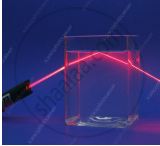
For a ray of light, the critical angle is minimum when it travels from ______.
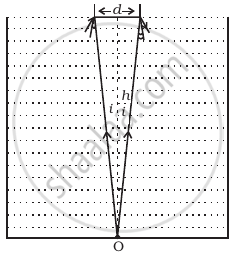
A jar of height h is filled with a transparent liquid of refractive index µ (Figure). At the centre of the jar on the bottom surface is a dot. Find the minimum diameter of a disc, such that when placed on the top surface symmetrically about the centre, the dot is invisible.